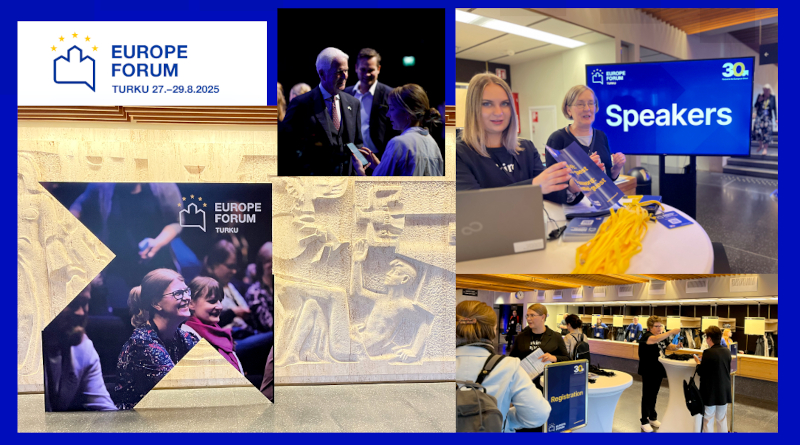
Europe Forum Insights 2024/5: Security, Competitiveness, Sustainability

Photo and Text © C.M. Cordeiro 2025.

Integrating Security, Competitiveness, and Sustainability: Insights from Europe Forum Debates 2024/5 and EU Projects

Introduction

Europe faces multiple, overlapping challenges: geopolitical instability, ecological pressures, and concerns over long-term economic competitiveness. These issues are often framed in policy debates as competing priorities. At the Europe Forum events in Turku (2024 and 2025), panelists frequently posed the question of whether EU resources should be directed toward defense and security or toward sustainable growth, cohesion, and agriculture [1]–[4]. This article explores how such framings may overstate the trade-offs. Drawing on Forum debates and ongoing EU projects, it examines the extent to which security, competitiveness, and sustainability can be understood as interdependent dimensions of a coherent European agenda.

1. Security as Competitiveness

At the 2024 Forum session on European competitiveness, it was emphasized that competitiveness is inseparable from security [1]. The upcoming EU Council Presidency was noted as placing emphasis on defense industry financing, border resilience, and energy independence. This reflects a growing recognition that secure borders, reliable energy systems, and resilient food and digital infrastructures underpin Europe’s ability to compete internationally.

Continue reading ”Europe Forum Insights 2024/5: Security, Competitiveness, Sustainability”
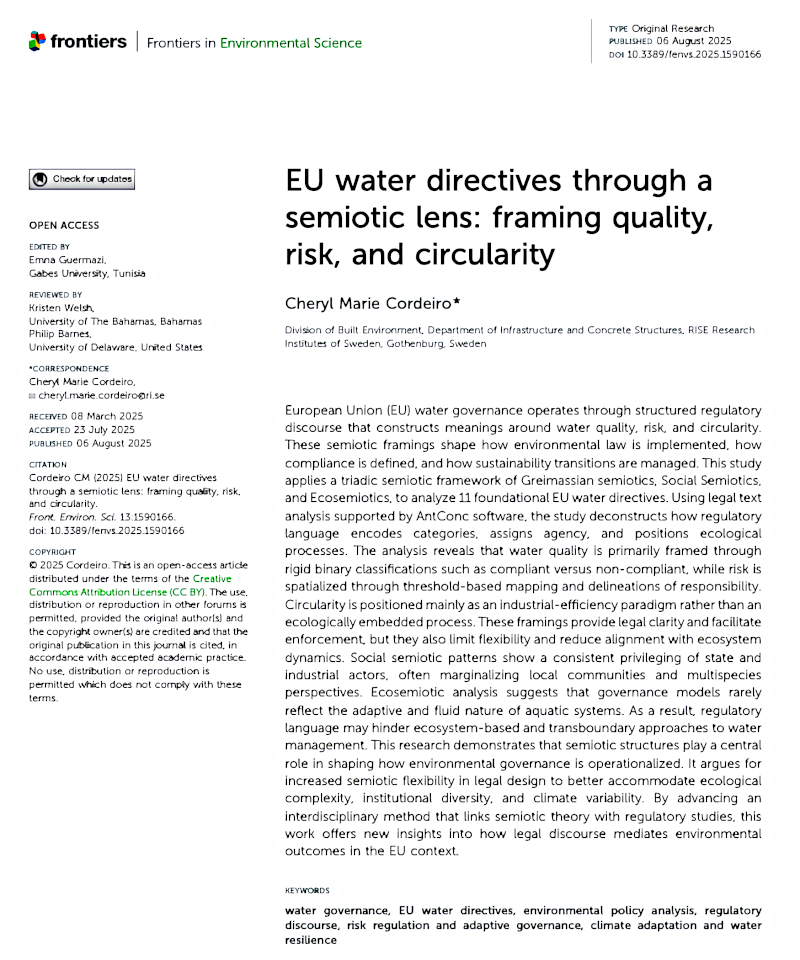
New publication: EU Water Directives through a Semiotic Lens: Framing Quality, Risk, and Circularity

Published in Frontiers in Environmental Science, August 2025
Cordeiro, C.M. (2025). EU water directives through a semiotic lens: Framing quality, risk, and circularity. Frontiers in Environmental Science, 13:1590166.

The European Union’s water governance framework is widely recognized for its clear legal architecture, offering predictable compliance structures and harmonized standards across Member States. Yet, the language that enables this clarity and coordination may also influence how environmental concepts are interpreted and implemented. Understanding how such language constructs meaning is essential for evaluating both the strengths and limitations of EU water policy.

Beyond Compliance: The Power of Language in Policy

EU water law not only regulates environmental behavior; it also plays a constitutive role in shaping how key policy concepts such as quality, risk, and circularity, are defined and operationalized. This study applies a triadic semiotic framework, drawing on Greimassian structuralism, Social Semiotics, and Ecosemiotics, to examine 11 foundational EU water directives, including the Water Framework Directive, the Nitrates Directive, and the Water Reuse Regulation. Through this lens, the analysis explores how regulatory texts frame environmental priorities, assign agency, and embed specific worldviews that influence implementation and policy outcomes.

Continue reading ”New publication: EU Water Directives through a Semiotic Lens: Framing Quality, Risk, and Circularity”