Text and Photo © 2026 CM Cordeiro
About ManuREsource
ManuREsource is an international conference dedicated to the exchange of knowledge and experience among researchers, policymakers, industry actors, and farmers on the policy measures, technologies, and valorisation strategies associated with livestock manure management. Organised by the Flemish Coordination Centre for Manure Processing (VCM), Ghent University, and Inagro, the conference series has grown steadily since its first edition in 2013 into one of Europe’s foremost gatherings in the field of circular nutrient management.
The conference rotates between Belgium and the Netherlands, reflecting the close collaboration between Flemish and Dutch expertise in addressing manure surplus challenges. Recent editions include:
| Edition | Year | Location |
|---|---|---|
| 4th | 2019 | Hasselt, Belgium |
| 5th | 2021/2022 | ’s-Hertogenbosch, the Netherlands |
| 6th | 2024 | Antwerp, Belgium |
| 7th (current) | 2026 | Ede/Wageningen, the Netherlands |
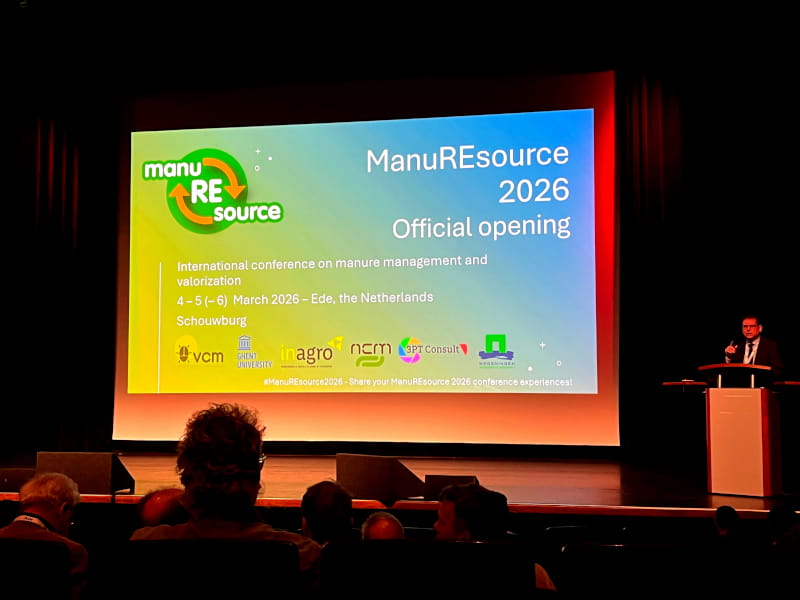
Each edition has built on the last, broadening its scope from manure surplus management to encompass innovations in treatment technology, nutrient recovery, valorisation for energy and food production, regulatory policy, and sustainability assessment. The 2026 edition, held 4–5 March at Hotel Reehorst in Ede/Wageningen, with an optional field trip on 6 March to local manure processing installations, continued this tradition under the central theme: manure as a resource.
Wageningen is an apt setting. Home to Wageningen University & Research, one of Europe’s leading institutions in food, agriculture, and environmental science, the region embodies the kind of research-to-practice integration that ManuREsource champions. The 2026 conference brought together scientists, engineers, farmers, consultants, and policymakers, alongside EU project teams using the occasion to disseminate findings from active Horizon Europe, LIFE, and national research programmes.
FERTITEC at ManuREsource 2026
The Project
FERTITEC (EU Horizon Europe CSA, grant 101181513) runs from January 2025 to December 2027 and is coordinated by RISE Research Institutes of Sweden. Bringing together seven partners across 15 countries in Europe and Africa, the project maps and analyses the landscape of alternative fertilisers derived from secondary raw materials — livestock waste, digestate, industrial by-products — with the aim of supporting their broader adoption through evidence-based policy tools, quality certification frameworks, and stakeholder engagement platforms.
The Presentation
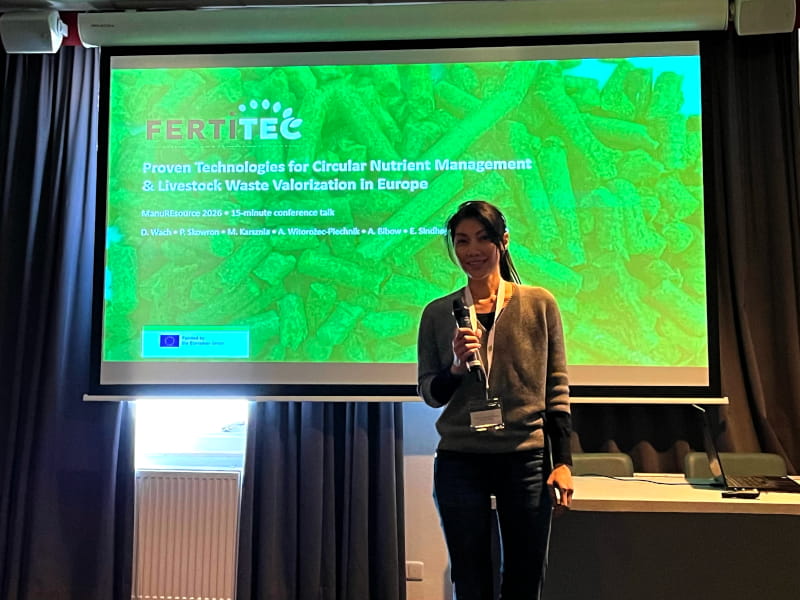
At ManuREsource 2026, part of the WP1 efforts of FERTITEC was presented by myself, in my role as Lead Coordinator. The abstract had main authors from the IUNG team — D. Wach, P. Skowron, M. Karsznia, A. Witorożec-Piechnik, and A. Bibow from the Institute of Soil Science and Plant Cultivation (IUNG), Puławy, Poland — who led the foundational WP1 mapping work on which the presentation was based. IUNG was not present at Wageningen; the findings were presented by Cordeiro as corresponding author.
The abstract presented was titled:
FERTITEC: Proven Technologies for Circular Nutrient Management and Livestock Waste Valorization in Europe
What Was Presented
The presentation reported findings from FERTITEC’s systematic mapping exercise, the most comprehensive public dataset of its kind to date in the project literature. 184 technologies, techniques, and practices were catalogued across Europe and selected African Union contexts, spanning the full spectrum of pathways for converting livestock waste and secondary raw materials into alternative fertilising products. The underlying data are publicly accessible through the project’s TechPractice dataset and the accompanying D1.1 report, available on Zenodo at https://doi.org/10.5281/zenodo.17423259.
The mapping drew on 18 EU and national projects, including B-Ferst, bioSOILUTION, CiNURGi, FERPLAY, FERTIMANURE, Kretsløp SIS, LEX4BIO, MainstreamBio, Novafert, NUTRI-KNOW, NUTRIMAN, P2GreeN, RavinneEmo, SEA2LAND, SuMaNu, SYSTEMIC, Växtnäring i osäkra tider, and WalNUT, making the dataset a genuine synthesis across the European project landscape rather than a project-siloed result.
Key findings included:
- Feedstock patterns: Agricultural biomasses dominate as the primary feedstock family, accounting for just over half of all recorded resource streams. Blue biomasses (aquatic and marine sources) are least represented, linked to geographic siting of installations and regional feedstock availability.
- Technology families: Core clusters include anaerobic digestion with digestate valorisation, composting and aerobic stabilisation, and chemical nutrient recovery processes — struvite precipitation, ammonia stripping and scrubbing, and membrane technologies. Advanced options such as pyrolysis to produce biochar are also captured. Product typologies are recorded against EU Fertilising Products Regulation categories (Regulation (EU) 2019/1009).
- Technology readiness: Most entries sit at TRL 8–9, and approximately 120 practices are at TRL 9, indicating proven operation under real-world conditions. Maturity is not the bottleneck.
- Stakeholder perspective: Interviews with 23 experts in Finland, Greece, Poland, and Spain — spanning consultants, producers, sector associations, and researchers — found that barriers are primarily institutional and market-related: regulatory fragmentation, high upfront costs, absent quality assurance frameworks for recycled products, and trust deficits among end-users. These are barriers of governance and policy coherence, not technology immaturity.
- National context, Sweden: Biogas production reached approximately 2.4 TWh in 2024, producing around 3.7 million tonnes of nutrient-rich digestate, most applied as fertiliser. Ammonia emissions stood at approximately 54 kilotonnes in 2023, around 90 percent from agriculture. Total estimated nitrogen load to water is approximately 150,000 tonnes per year, with diffuse agricultural sources dominant.
Overarching conclusion: Deployment at scale is the central challenge, not the absence of ready technologies. Progress requires coherent policy and incentive structures, recognised quality certification for recycled nutrient products, robust demonstration pathways, and cross-sector coordination. The open TechPractice database provides the evidence base to underpin exactly this kind of policy and investment dialogue.
Beyond the Dataset
ManuREsource 2026 arrived at a moment when the European agricultural sector is navigating simultaneous pressures: the implementation of the EU Fertilising Products Regulation, ongoing negotiations over the revision of the Nitrates Directive, and the broader imperative, affirmed through the EU Mission on Soil Health and other policy frameworks, to close nutrient loops and reduce the sector’s dependence on mineral fertilisers whose production is energy-intensive and geopolitically exposed.
FERTITEC’s contribution at Wageningen sits squarely within this context. By demonstrating that the technology toolbox is already mature and that the frontier of work is now in governance, certification, and market development, the project provides a clear evidential basis for where European policy effort and public investment should be directed.
The public dataset, built on 18 existing EU and national projects, updated to reflect current technology readiness levels and regulatory classifications, and freely available on Zenodo, is designed not as a project deliverable that sits on a shelf, but as a living resource that project teams, national competent authorities, and policy analysts can interrogate and build upon.
References
Cordeiro, C. M., & Sindhøj, E. (2024). Situating the discourse of recycled nutrient fertilizers in circular economy principles for sustainable agriculture. Frontiers in Sustainability, 5, 1465752. https://doi.org/10.3389/frsus.2024.1465752
Skowron, P., Karsznia, M., Wach, D., Witorożec-Piechnik, A., & Bibow, A. (2025). D1.1 Current available circular fertilising practices, dataset and report. Zenodo. https://doi.org/10.5281/zenodo.17423259
ManuREsource 2026 conference website: https://www.manuresource.org
VCM (Flemish Coordination Centre for Manure Processing): https://www.vcm-mestverwerking.be
FERTITEC project: https://fertitec-project.eu/
FERTITEC is funded under the European Union’s Horizon Europe programme, grant agreement 101181513. The views expressed are those of the authors and do not necessarily reflect those of the European Union or the Research Executive Agency.