
Image credit: Lachlan Turczan / Google, “Making the Invisible Visible,” Milan Design Week 2025.
The Invisible Return: A spillover pathway for EU agricultural research investment
A reflection on evaluation frameworks, spillover effects, and what infrastructure economics might teach us about Horizon tools
Horizon Europe represents one of the most substantial public commitments to agricultural research and innovation in the world, funding multi-actor projects, thematic networks, living labs, and knowledge exchange platforms designed to accelerate the transition to more sustainable, productive, and resilient farming systems. Yet as each programme cycle matures, a familiar challenge tends to re-emerge: how do we demonstrate that this investment actually works?
This article draws on ideas from infrastructure economics to reflect on why the challenge remains, suggesting that the issue may lie not in the absence of impact, but perhaps in where and how we choose to look for it.
What We Measure, and What We Miss
Current evaluation practice in EU agricultural research tends to focus on what programmes produce: scientific publications, technology prototypes, farmer training events, practice-ready guidelines, policy briefs, and social media outreach. These outputs are visible, countable, and reportable. They satisfy audit requirements and feed neatly into monitoring dashboards. But they tell us surprisingly little about whether research investment actually changes what happens on the ground.
The gap between outputs and outcomes is well recognised in the impact assessment literature. Weiβhuhn et al. (2018) reviewed decades of research impact assessment in agriculture and found that evaluations are systematically skewed toward economic and bibliometric indicators, with environmental and behavioural impacts left substantially underassessed despite being arguably the most policy-relevant outcomes in the current Horizon Europe context. More recently, Faure et al. (2024) tested a multi-dimensional societal impact framework across three agricultural research case studies and found that frameworks assuming simple cause-and-effect attribution consistently underperform compared to approaches grounded in contribution logic and systems thinking. In the Horizon agriculture context, a recent EU CAP Network study covering nearly 1,000 Operational Group projects found that while knowledge co-creation was broadly positive, tracing the pathway from project outputs to farm-level behaviour change remained methodologically elusive (EU CAP Network, 2024). This is not a criticism of the projects themselves; it is a reflection of the evaluative tools available to assess them.
The challenge is compounded by timing. Horizon multi-actor projects typically run for four to six years, yet meaningful innovation uptake by farmers and foresters often happens well after project closure, and through actors who were never formal project partners. An advisor trained during a project goes on to work with dozens of farmers who may never have heard of Horizon Europe. A thematic network infosheet circulates through regional advisory systems long after the funding period ends. A living lab becomes a demonstration site that influences neighbouring farms and informs regional policy. None of this is captured in standard output monitoring, yet all of it arguably constitutes the real return on public investment.
Figure 1 below offers a schematic of this argument: current evaluation largely captures stages 1 and 2 of the pathway, the public investment and its immediate outputs, while stages 3 through 5, the friction reduction, spillover effects, and longer-term public value, remain mostly under-observed.
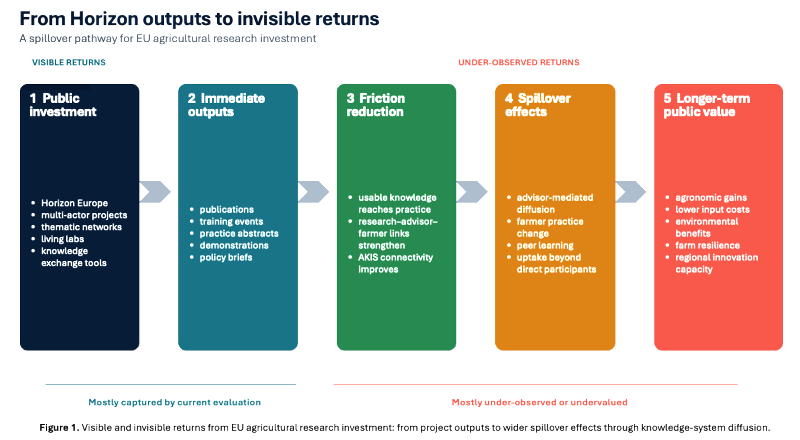
Figure 1. Visible and invisible returns from EU agricultural research investment: from project outputs to wider spillover effects through knowledge-system diffusion.
A Framework from an Unlikely Source
A body of work from infrastructure investment economics offers a suggestive conceptual bridge here.
Over the past decade, Yoshino and colleagues have developed an empirical framework for understanding what they term the spillover effects of public infrastructure: the economic benefits that accrue not to direct users of an investment, but to the wider regional economy through increased employment, private investment, business activity, and ultimately, government tax revenues (Yoshino, Helble, and Abidhadjaev, 2018; Yoshino and Abidhadjaev, 2017; Yoshino et al., 2022). Applied to cases as varied as a Philippine toll highway, a Japanese high-speed railway, and a mobile tower construction programme in rural India, the consistent finding is that the total social return on public infrastructure substantially exceeds what direct user fees capture, and that conventional evaluation frameworks, by focusing only on direct returns, may systematically understate the case for investment.
The mechanism matters. In the infrastructure cases, the causal chain runs roughly as follows: public investment reduces friction in transport, connectivity, or information access; economic actors respond with increased activity through new businesses, higher employment, and expanded sales; government collects higher tax revenues; and a portion of those revenues can be recycled to improve the financial viability of the original investment. Yoshino and Abidhadjaev (2017) demonstrate this empirically using a difference-in-difference design comparing prefectures served by the Kyushu Shinkansen with unaffected prefectures, finding statistically significant effects on both total tax revenues and personal income tax in the years following rail connection.
The parallel with Horizon knowledge tools, while imperfect, seems worth exploring. A multi-actor project connecting researchers, farmers, and advisors across several member states arguably reduces a specific kind of friction: the gap between scientific knowledge and farm-level practice. If that friction reduction enables changes in farming behaviour that would not otherwise have occurred, then something like a spillover effect is plausible, with agronomic improvements, input cost reductions, reduced environmental externalities, and improved farm viability diffusing far beyond the direct project participants. Whether these effects are large enough to measure, and through what channels they operate, remains an open empirical question, but arguably a more tractable one than it might first appear. The OECD’s recent agricultural policy monitoring work offers some support for this intuition, noting that public investment in general services such as research, innovation, and extension, despite constituting only around 12.6% of total agricultural support globally, consistently generates some of the highest returns on investment of any form of farm support, while also contributing most directly to sustainable productivity growth (OECD, 2024).
The Rural Dimension
One finding from the infrastructure spillover literature deserves particular attention for those working in the Horizon agriculture space. Across multiple studies, spillover effects from connectivity-enhancing investments tend to be proportionally larger in rural and peripheral areas than in urban ones (Yoshino et al., 2022). The reasoning is intuitive: rural areas start from a lower base of market connectivity and information access, so investments that reduce friction have proportionally greater effects. Agricultural knowledge and innovation systems (AKIS) in peripheral EU regions are often thinner, advisory services less well-resourced, and farmer access to research outputs more limited.
If the same logic applies to knowledge infrastructure as to physical infrastructure, Horizon tools may be generating their largest returns precisely in the regions where they are hardest to observe through conventional output monitoring. This resonates with concerns in current AKIS scholarship that the digital and knowledge transition in agriculture risks widening rather than narrowing the gap between well-connected and peripheral farming systems (Birke et al., 2022; Charatsari et al., 2023). Understanding whether Horizon tools are reinforcing or counteracting that tendency may be one of the more consequential questions the field could currently address.
What Would It Mean to Evaluate Differently?
It is not suggested here that infrastructure evaluation methods can be imported wholesale into agricultural research assessment; the differences are real and significant. Physical infrastructure has a clear spatial footprint that allows credible treatment and control groups to be defined geographically. Horizon knowledge tools are more diffuse: a thematic network infosheet downloaded by an advisor in one country may influence a farmer in another through channels that leave no administrative trace. The causal chain is longer, noisier, and harder to instrument.
But some elements of the spillover evaluation approach seem worth adapting. A two-stage causal model, asking first whether a Horizon tool changed the behaviour of its direct participants, and second whether those behavioural changes propagated through advisory networks and practice communities to affect a wider population, would represent a meaningful advance over current output-counting approaches. This aligns with what Faure et al. (2024) describe as a shift from attribution to contribution logic: rather than asking “did this project cause this outcome?”, the evaluator asks “did this project plausibly contribute to this outcome, and through what pathway?” Quasi-experimental designs using matched comparison groups, even imperfect ones, would allow more credible inference than before-after comparisons. Explicitly modelling contextual moderators such as absorptive capacity of regional advisory systems, farmer education levels, and density of existing knowledge networks would also help explain why the same Horizon tool appears to generate different returns in different places. Yoshino and Abidhadjaev’s (2016) finding that the impact of infrastructure investment is significantly amplified by education level points in precisely this direction: the return on a knowledge tool is likely conditioned by the capacity of the system it enters.
Towards a Cross-disciplinary Impact Assessment Methodology
The suggestion here is not that current Horizon evaluation is without value, nor that spillover economics offers a ready-made solution. It is, rather, that the conversation about how we assess the return on EU agricultural research investment might benefit from reaching across disciplinary boundaries, drawing on impact assessment methodology, infrastructure economics, and AKIS scholarship together.
If that return is substantially larger than output monitoring currently reveals, the stakes are real: better evidence would support stronger policy arguments, more targeted programme design, and a clearer account of Horizon’s contribution to the European Green Deal. Getting a clearer picture, even an approximate, hedged, methodologically honest one, seems like a worthwhile collective endeavour.
References
Birke, F. M., Bae, S., Schober, A., Wolf, S., Gerster-Bentaya, M., and Knierim, A. (2022). AKIS in European countries: Cross analysis of AKIS country reports from the i2connect project. i2connect H2020 Project. https://i2connect-h2020.eu/wp-content/uploads/2022/12/2022-12-02-AKIS-cross-analysis_updated.pdf
Charatsari, C., Michailidis, A., Lioutas, E. D., Bournaris, T., Loizou, E., Paltaki, A., and Lazaridou, D. (2023). Competencies needed for guiding the digital transition of agriculture: Are future advisors well-equipped? Sustainability, 15(22), Article 15815. https://doi.org/10.3390/su152215815
EU CAP Network. (2024). Study on outcomes achieved by EIP-AGRI Operational Group projects under the CAP. European Commission. https://eu-cap-network.ec.europa.eu/publications/study-outcomes-achieved-eip-agri-operational-group-projects-under-cap_en
Faure, G., Barret, D., Blundo-Canto, G., and Temple, L. (2024). Participatory ex-ante impact assessment for interactive research and development in agriculture and food systems. Impact Assessment and Project Appraisal, 42(2), 160–172. https://doi.org/10.1080/14615517.2024.2330792
OECD. (2024). Agricultural policy monitoring and evaluation 2024: Innovation for sustainable productivity growth. OECD Publishing. https://doi.org/10.1787/74da57ed-en
Weiβhuhn, P., Helming, K., and Ferretti, J. (2018). Research impact assessment in agriculture: A review of approaches and impact areas. Research Evaluation, 27(1), 36–46. https://doi.org/10.1093/reseval/rvx034
Yoshino, N., and Abidhadjaev, U. (2016). Impact of infrastructure investment on tax: Estimating spillover effects of the Kyushu high-speed rail line in Japan on regional tax revenue (ADBI Working Paper No. 574). Asian Development Bank Institute. https://www.adb.org/publications/impact-infrastructure-investment-tax-estimating-spillover-effects-kyushu-high-speed-rail
Yoshino, N., and Abidhadjaev, U. (2017). Impact of infrastructure on tax revenue: Case study of high-speed train in Japan. Journal of Infrastructure, Policy and Development, 1(2). https://doi.org/10.24294/jipd.v1i2.69
Yoshino, N., Helble, M., and Abidhadjaev, U. (Eds.). (2018). Financing infrastructure in Asia and the Pacific: Capturing impacts and new sources. Asian Development Bank Institute. https://www.adb.org/publications/financing-infrastructure-asia-capturing-impacts-and-new-sources
Yoshino, N., Siregar, T. H., Agarwal, D., Seetha Ram, K. E., and Azhgaliyeva, D. (2022). An empirical evidence and proposal on the spillover effects of information and communication technology infrastructure in India (ADBI Working Paper No. 1330). Asian Development Bank Institute. https://doi.org/10.56506/DWEH4685