Abstract
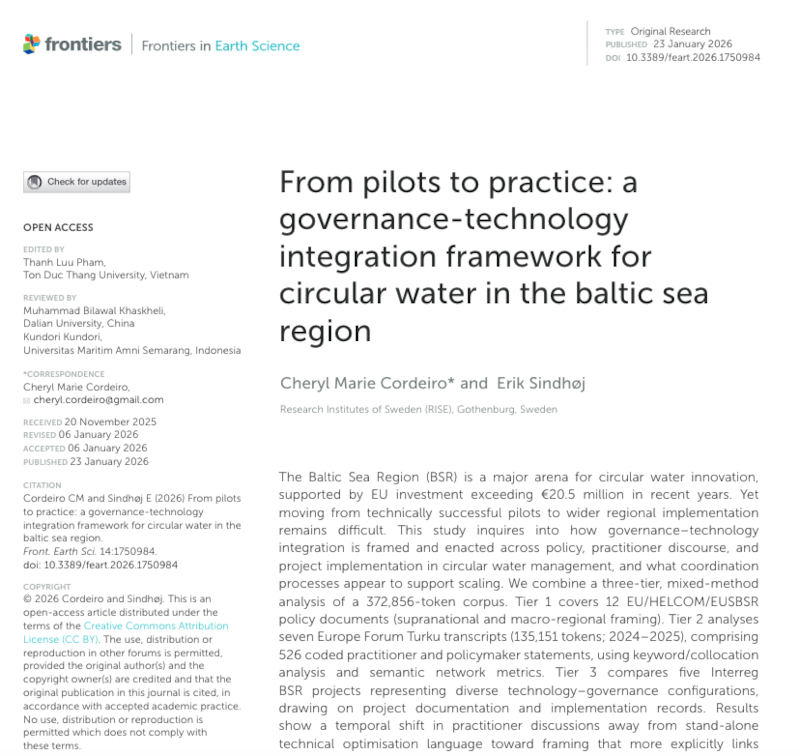
A new study published in Frontiers in Earth Science presents a data-driven framework for understanding how circular water technologies can successfully transition from pilot projects to widespread regional implementation. Using computational text analysis of 372,856 tokens from EU policy documents, practitioner forums, and five Interreg Baltic Sea Region projects, the research identifies three critical coordination mechanisms, structural, knowledge, and temporal, that enable effective governance-technology integration across multiple scales. The findings reveal a temporal shift in practitioner discourse from technical optimization toward strategic governance framing, highlighting the importance of adaptive coordination processes in scaling circular water innovations.
Addressing a Critical Challenge in Environmental Governance
The Baltic Sea Region has emerged as a major arena for circular water innovation, with EU investment exceeding €20.5 million in recent years. Yet despite technically successful pilots, moving from demonstration projects to broader regional implementation remains challenging. Our newly published research tackles this persistent ”pilot-to-practice” problem by examining how governance and technology integration is actually framed, discussed, and implemented across policy, practitioner, and project contexts.
A Novel Computational Approach
This study employs a three-tier analytical framework combining:
- Tier 1: Analysis of 12 EU/HELCOM/EUSBSR policy documents examining governance signatures and policy integration terms
- Tier 2: Computational analysis of Europe Forum Turku transcripts (135,151 tokens; 2024-2025) tracking discourse evolution
- Tier 3: Comparative assessment of five Interreg BSR projects representing diverse technology-governance configurations
Using AntConc for lexico-collocational mining and InfraNodus for semantic network analysis, the research provides reproducible, quantitative evidence of how coordination mechanisms emerge and function across institutional scales.
Key Findings: Three Coordination Mechanisms
The analysis identifies three coordination mechanisms that recur as central to successful scaling:
1. Structural Coordination
Cross-border policy platforms and regulatory alignment create enabling conditions while maintaining regional differentiation. The systematic co-occurrence of policy terminology with implementation language across 448 instances demonstrates integration is systemic across the policy corpus.
2. Knowledge Coordination
Practitioner forums function as knowledge integration hubs that translate policy priorities into shared technical and operational repertoires. The research documents 22 co-occurrences of ”best” near ”action” terms, reflecting knowledge transfer mechanisms.
3. Temporal Coordination
Policy cycles, funding horizons, and technology development timelines must align for scaling to occur. The corpus analysis reveals shifts from 2024 discussions dominated by technical terms toward 2025 discourse increasingly framed by resilience, security, and strategic governance language.
From Technical Optimization to Strategic Integration
A particularly significant finding is the discourse evolution observed in the Tier 2 forum analysis. In 2024, practitioner discussions focused predominantly on technical aspects (178 mentions of nutrient recycling or wastewater treatment plants). By 2025, strategic terms linking circular water technologies to resilience and security agendas increased substantially, with security-technology co-mentions rising and new strategic bridging vocabulary emerging.
This temporal shift suggests that successful scaling depends not only on technical performance but on articulating circular water innovations within recognized strategic frames that resonate across governance levels and sectoral boundaries.
Three Pathways to Scaling
Examining the five Interreg BSR projects revealed three distinct integration pathways:
- Pathway 1 (P1): Technical optimization → Regulatory compliance → Market integration
- Pathway 2 (P2): Stakeholder engagement → Policy innovation → Network effects
- Pathway 3 (P3): Technology development → Governance innovation → System transformation
Projects like CiNURGi demonstrate mature scaling where technology development is coupled with governance innovation and system-level change, while others represent earlier-stage regulatory compliance strategies or stakeholder engagement approaches.
Implications for Policy and Practice
The research offers two key practical implications:
First, project selection and monitoring should explicitly assess post-pilot readiness, including permitting pathways, standards alignment, credible ownership, and maintenance arrangements rather than treating these as downstream concerns.
Second, to reduce replication friction across jurisdictions, programmes and regional actors should prioritize reusable translation tools, templates, shared baselines, structured feedback loops, that stabilize knowledge coordination and make implementation routines portable without requiring new institutional structures.
Looking Forward
This governance-technology integration lens is transferable beyond water management to other environmental technology domains requiring multi-scale coordination, including energy transition, biodiversity conservation, and climate adaptation initiatives. Future research directions include comparative multi-regional analysis, longitudinal tracking beyond project funding cycles, and integration of social network analysis to understand how practitioner communities influence diffusion beyond formal policy channels.
Reference
Cordeiro, C. M., & Sindhøj, E. (2026). From pilots to practice: A governance-technology integration framework for circular water in the Baltic Sea Region. Frontiers in Earth Science, 14, Article 1750984. https://doi.org/10.3389/feart.2026.1750984
About the Authors
Cheryl Marie Cordeiro and Erik Sindhøj are researchers at the Research Institutes of Sweden (RISE) in Gothenburg, Sweden, specializing in environmental governance, circular economy, and Baltic Sea Region sustainability transitions.
Funding
This research was conducted within the CiNURGi project, funded from the EU Interreg Baltic Sea Region Programme 2021-2027, grant #O049. CiNURGi is co-funded by the European Regional Development Fund (ERDF) with a total budget of €6.54 million.
This open access article is distributed under the terms of the Creative Commons Attribution License (CC BY), which permits unrestricted use, distribution, and reproduction in other forums, provided the original author(s) and the copyright owner(s) are credited.