The Biotech Center, Gothenburg, Sweden

Biotech Center, Gothenburg, Sweden, Green Lift.

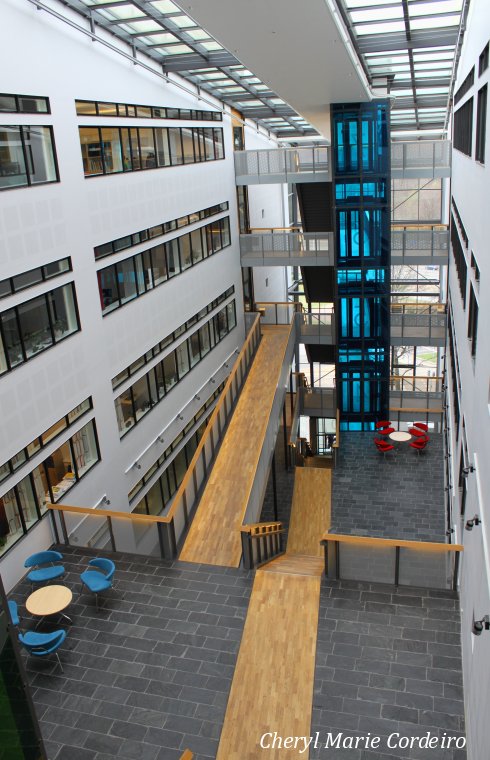
View from the Green Lift of the Biotech Center, Gothenburg, Sweden.
Photo: C M Cordeiro-Nilsson and PO Larsson © 2011

The Biotech Center in Gothenburg was designed by Per Henrik Johansson at Liljewall Arkitekter ab as a part of the Sahlgrenska Science Park of the city. It is in fact one of my favourite modern buildings in the city of Gothenburg because this building, that houses mostly biotechnology and innovation companies, is to me the very concrete extension of innovative design and architecture.

Since its opening in 2004, it has become today, a star attraction to many of our visitors who come from abroad, of which its most interesting features are reflected in this article in Arkitektur 4:2004 (Pdf file 4.8Mb), in a journal on architecture that describes in greater detail, the Biotech Center project.
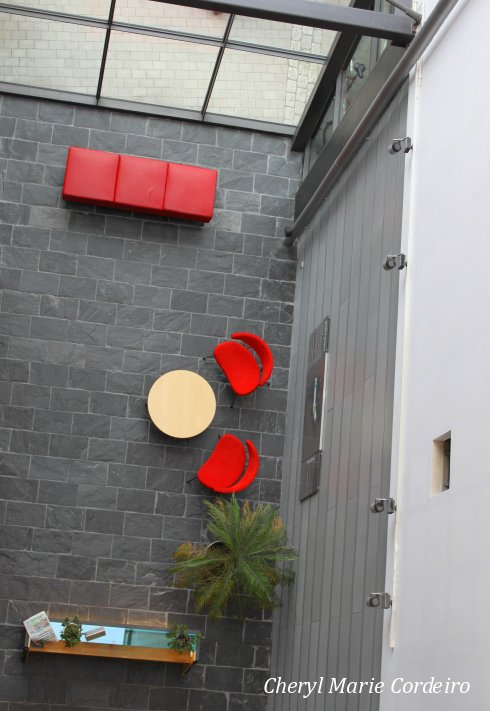
Biotech Center Gothenburg, reception.

Reception.

Tall glass walls, expansive windows and a glass ceiling contributes to the builidng’s incredible lightness of structure, a feature that attracts the attention of most visitors to the building. The glass ceiling also has the function of letting in as much light as possible during the long dark winter days, and during spring and summer, the inside of the building turns into an indoor garden of sorts with what seems like infinite sunlight streaming in through the diverse glass panels.
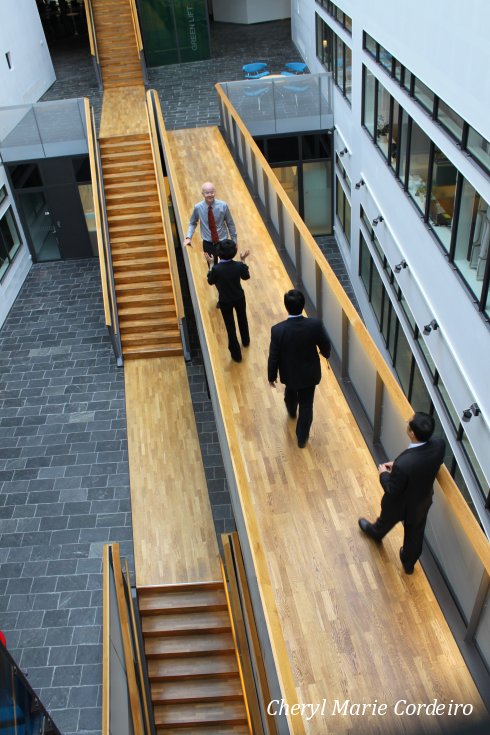
Biotech Center, Gothenburg, bridge.

A bridge that takes people between the two different lift landings.
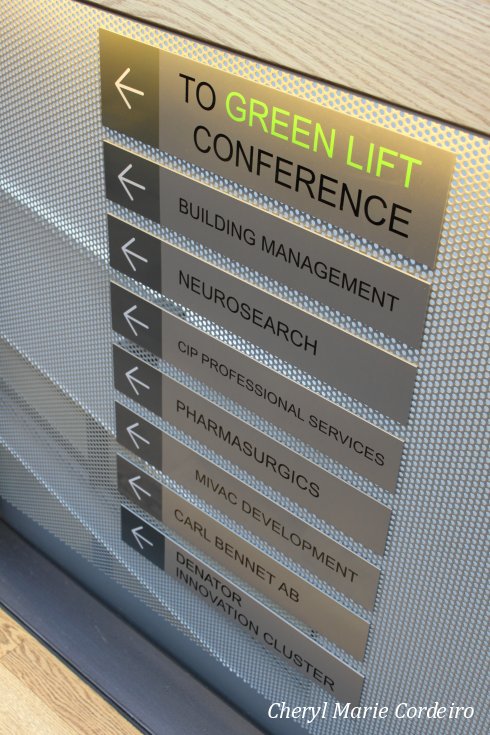
Biotech Center, organizations.

The names of some of the companies housed at the Biotech Center.
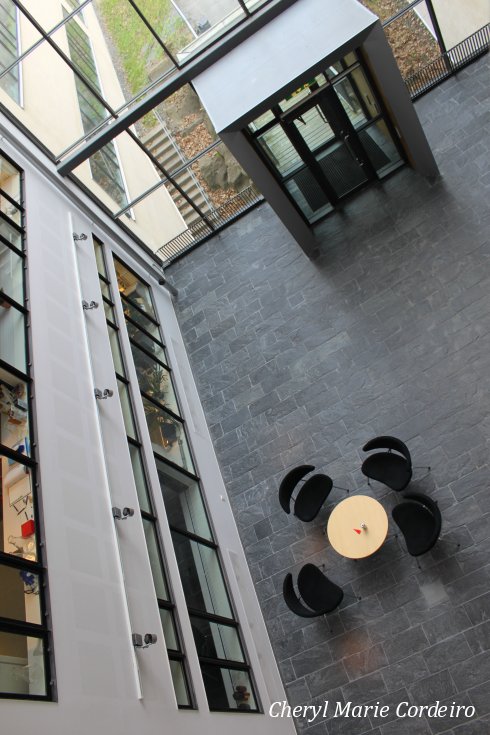
Biotech Center, Gothenburg, back entrance.

Back entrance.

Shanghai University visit, Biotech Center, Gothenburg, Sweden.

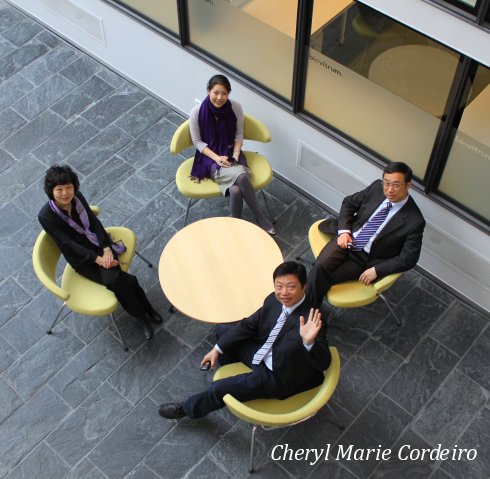
Sitting in one of the building’s landings with a delegation from the Shanghai University, China.
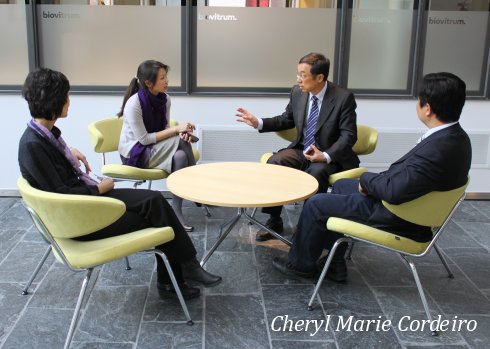
Group talk, Shanghai University at the Biotech Center, Gothenburg, Sweden.

Group talk.
From L-R: Sherry Zhang of the International Relations Office, Shanghai University; Dr. Cheryl Cordeiro-Nilsson, University of Gothenburg; Professor Zhuang Enping and Professor Hao Jian, Shanghai University.
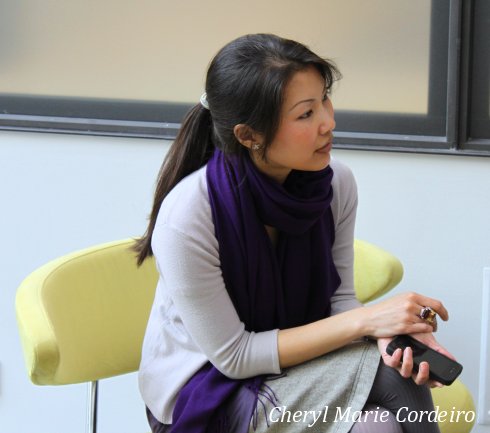
Dr. Cheryl Cordeiro Nilsson, with Shanghai University delegates, Biotech Center, Sweden.

Dr. Cheryl Cordeiro-Nilsson, with delegates from the Shanghai University.
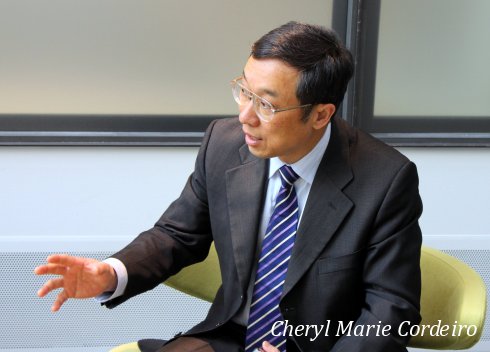
Professor Zhuang Enping, Shanghai University, in Sweden.

Professor Zhuang Enping, Shanghai University, China.

Furnished in clean, solid coloured tables and chairs, the building also features several indoor patios or landings that allow for mix and mingle sessions outside its main conference or seminar room that seats about 45 persons.

With a gym, a sauna and a roof top suite that allows for summer barbecues and surround sound movie screenings, I think many of us here in the building are unashamedly looking forward to the upcoming season!


The Swedish East Indiaman Gotheborg – and the tiger economy of Sweden

Cheryl Marie Cordeiro, Gotheborg III 1

In 2003, launching of the Swedish East Indiaman Gotheborg III
Photo © JE Nilsson and C M Cordeiro-Nilsson for CMC 2003-2011

My personal involvement in the Swedish East Indiaman Gotheborg III project was so early that I had not myself realized it back then. In the project newspaper GotheborgsPosten that was distributed in 360,000 copies throughout the entire western Sweden in 1996, it was outlined that one of the research objectives that would be targeted was Swedish-Chinese Business Communication. The Professor that in 2003 would arrange for me to receive the Anna Ahrenberg Research Funding Scholarship to help me start a PhD research (graduated in 2009) in doing precisely that, was interviewed. Strange indeed are the paths of life. Today, I go off to work everyday by ferry straight across Wargö Håla, the historic departure point of the Swedish East Indiamen in the western Swedish archipelago. In fact the house in which we live features one of the ship’s actual water provision wells in our very garden.

Currently at work, at the University of Gothenburg School of Executive Education AB, prevalent topics of discussion circle around Swedish-Chinese business relations and the future of work prospects with Sweden’s competitive growing economy that earned acknowledged nods from Swedish leaders, specifically that of its Finance Minister, Anders Borg, of the country being a Nordic tiger economy (ref. Di, DagensPS and Epoch Times). All this showing that the Swedish East Indiaman still has a relevant role to play, more so today than ever in its importance of growing global contacts. Its shared goodwill initially created by the East Indiaman Project is everywhere present.

In the media recently, a passionate discussion has arisen about what to do with the ship, now when its initiating ideas have been completed – the ship built and it has traveled to China and back. What now?

Many suggestions including turning it into a museum, an amusement park and why not – firewood – have come forth. Personally not even at today’s energy prices does the idea of firewood sound very brilliant.

Eventually, the original Founders of the project have chosen to step forth, and in this weekend’s local newspaper GP, have briefly presented their views of how the ship could continue to earn its keep and do much more than that.

The following article were published in GP, in January 22, 2011, as part of the ongoing debate about the future of the Swedish East Indiaman Gotheborg III ship.

Cheryl Marie Cordeiro, Gotheborg III 2

H.M. King Carl XVI Gustaf and H.M. Queen Silvia, disembark the Gotheborg III in Canton, China, 2006.

From the point of view of Anders Wästfelt and the Think Tank Gotheborg, the ship is far from done sailing:

”In view of the past few days defensive debate in the media and our City Council, on the future of the East Indiaman Gotheborg, it is time to lift our eyes beyond the horizon. In the right hands the Götheborg III – our ship – is a regional and national asset with huge potential.

She has great future tasks, functioning as a symbol of our community, an inspiration for continued work and as a source of financial revenues. She is well-built and with proper maintenance, she can sail for another 20-30 years.

The project to build a replica of the 1700s Swedish East Indiaman began in 1992 as a private initiative. It was well thought through and enjoyed the support of international shipbuilding expertise, the best marketing specialists, lawyers, economists, politicians, sinologists, university faculties as well as members of the Swedish Ministry of Foreign Affairs and the Swedish Trade Council.”
Continue reading ”The Swedish East Indiaman Gotheborg – and the tiger economy of Sweden”

La Vie En Rose at The Astor House Hotel, Shanghai

Cheryl Marie Cordeiro The Astor Shanghai

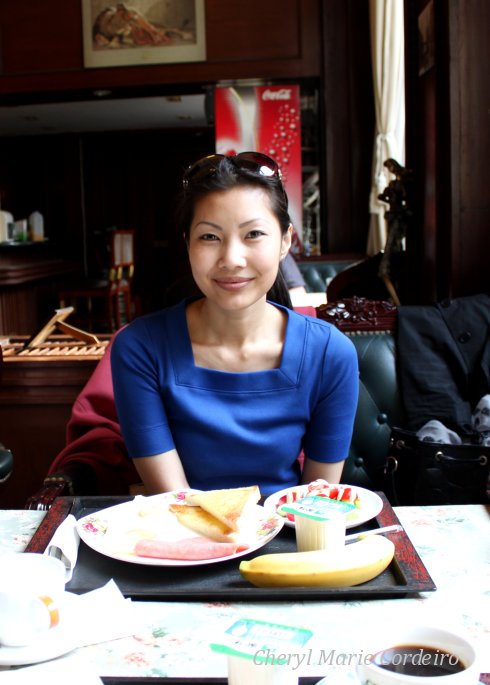
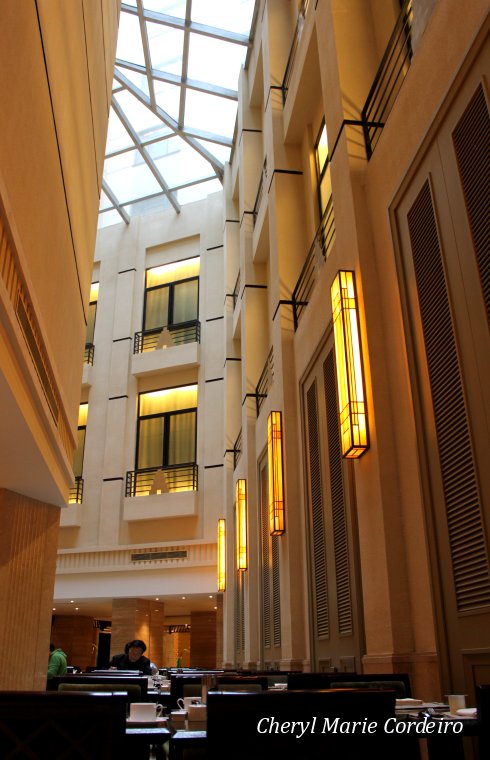
Breakfast at La Vie En Rose, the Astor House Hotel in Shanghai, along the Bund.
Photo © Yina Huang, P O Larsson and C M Cordeiro-Nilsson for CMC 2010

Every New Year most people will find themselves writing new resolutions for the year ahead – a healthier year ahead, a more successful year ahead, new goals to be attained or renewed interests in old goals previously unattained – but for me, as 2010 passes and this night welcomes 2011, I can’t help but go back to what has been there for a very long time. A time when I was growing up, of photographs now a natural sepia in family albums.

One such place where time has seemingly stood still, and which now come to mind from my travels in the past year is The Astor House Hotel along the Bund in Shanghai. Continue reading ”La Vie En Rose at The Astor House Hotel, Shanghai”

Swedish Lucia in Singapore

Cheryl Marie Cordeiro, Swedish Business Association Singapore SBAS gala 2010

Choice of dress for the evening, a gold champagne gown by my good friend and favourite designer Francis Louis Ler of Amor Meus, 36 Purvis Street in Singapore.
J E Nilsson and C M Cordeiro-Nilsson © 2010

The one thing that strikes you when you land coming into Singapore from the Swedish west coast which is right now experiencing one of its coldest winters in a century at -11 C and several inches of snow, is the wall of humidity and the tropical warmth that surrounds your very being. I was instantly relieved and even reveled in the tropical thunderstorm that greeted me when touching down in Singapore.

But as events go, I was not going to miss Sweden this Christmas because I was just in time for the Swedish Business Association of Singapore (SBAS) to host their annual Julbord and celebration of Saint Lucia. Continue reading ”Swedish Lucia in Singapore”

Visiting the Geely Holding Group in Hangzhou, November 2010

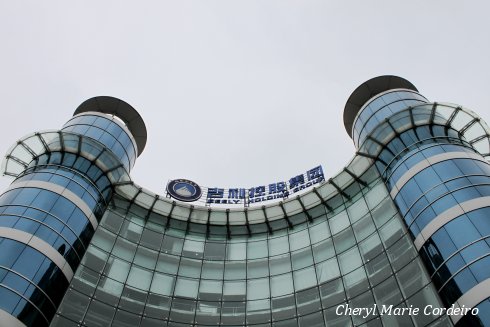
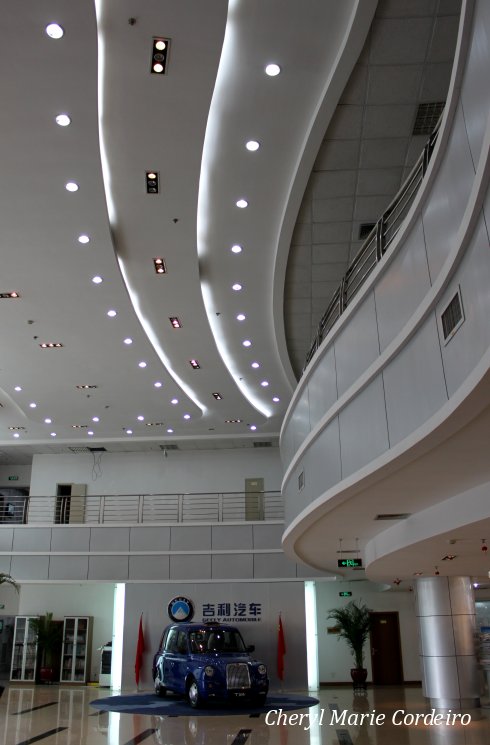
Geely headquarters, Hangzhou, China.

The Geely Holding Group headquarters in Hangzhou, November 2010
Photo: J E Nilsson and C M Cordeiro-Nilsson for CMC © 2010

It was with great expectations that I went to visit the Geely headquarters in Hangzhou, the Zhejiang Geely Holding Group Co. Ltd, as part of a Swedish delegation from the University of Gothenburg. Geely’s acquisition of the Swedish car manufacturer Volvo with their headquarters in Gothenburg was announced on Monday the 2 August 2010 and with that, the Zhejiang Geely corporation had concluded the largest ever acquisition of a foreign car company in the history of China.

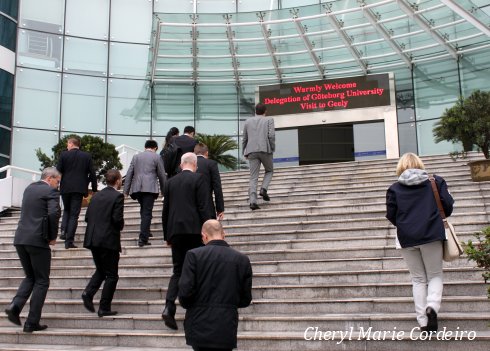
Geely headquarters, University of Gothenburg visit 2010.

A warm sign at the Zhejiang Geely Holding Group headquarters that welcomed the visit by the Swedish delegation.

Geely headquarters, hallway.

Just inside the Geely headquarters entrance.

Having followed the Ford and Geely negotiations as well as could be done in the press, I expected this acquisition to be an important opportunity to study the process of top management knowledge transfer between modern China and the West. Continue reading ”Visiting the Geely Holding Group in Hangzhou, November 2010”

Sunrise in Shanghai 2010

The Hengshan Picardie Hotel, Shanghai

Morning skylight, at the Hengshan Picardie Hotel, Shanghai.
Photo © C M Cordeiro-Nilsson and Per-Olof Larsson for CMC 2010

And I thought I would walk into a city that would be so foreign to me that I would not have understood half of what was going on as soon as I landed. But I was wrong. In fact, the melding I felt to Shanghai was so immediate it was as if I had stepped off the plane, right back home.

One of the things I look forward to whether travelling or at home, is breakfast. Shanghai, being such a dynamic and cosmopolitan city, has no problems providing for all sorts of palates. In fact, settling for both a red bean steamed bun and a mini chocolate muffin at breakfast was just the sort of thing that a Singaporean for example, wouldn’t think twice about either. Continue reading ”Sunrise in Shanghai 2010”

The RESER 20th Anniversary Conference Gala Dinner, Gothenburg 2010

2 Patrik Ström and Cheryl Marie Cordeiro, RESER's local organizing committee 2010.

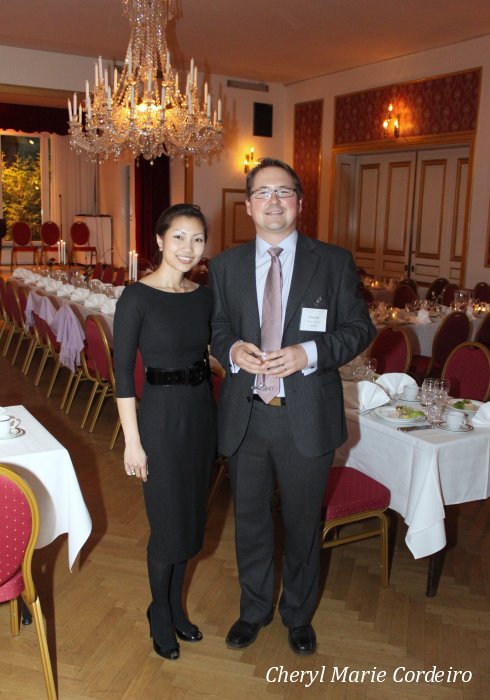
Dr. Cheryl M. Cordeiro-Nilsson and Associate Professor Patrik Ström (Chairman of the local Organizing Committee for RESER 2010), a last inspection of the Odd Fellows Estate grand hall, prior to dinner.
Photo © J E Nilsson and C M Cordeiro-Nilsson for CMC 2010

The 30th September to 2 October, 2010 saw the world’s leading researchers in the field of Services Research gather in Gothenburg, Sweden, for their annual conference.

The Chairman of the local Organizing Committee for RESER 2010 was Patrik Ström, Associate Professor, Docent, PhD, Ek.Dr. Staffan Helmfrid Pro Futura Fellow at the School of Business, Economics and Law, University of Gothenburg, whom I had the pleasure to assist in the materializing of this event. Continue reading ”The RESER 20th Anniversary Conference Gala Dinner, Gothenburg 2010”

Fika and the Swedish Management style

Cinnamon roll served with milk; kanelbullar med mjölk

The Cinnamon Roll – a Swedish fika staple.
Photo © J E Nilsson and C M Cordeiro-Nilsson for CMC 2010

Before Sweden, I only ever heard of the British inherited concept of afternoon Tea in Singapore from my grandparents, more specifically, my paternal grandmother. She often served Royal Danish butter cookies, of which I favoured the ones with raisins and those that came coated with granulated sugar on top. Light sponge cakes were sometimes served at these sessions, and accompanying these cookies and cakes was tea, with lots of milk.

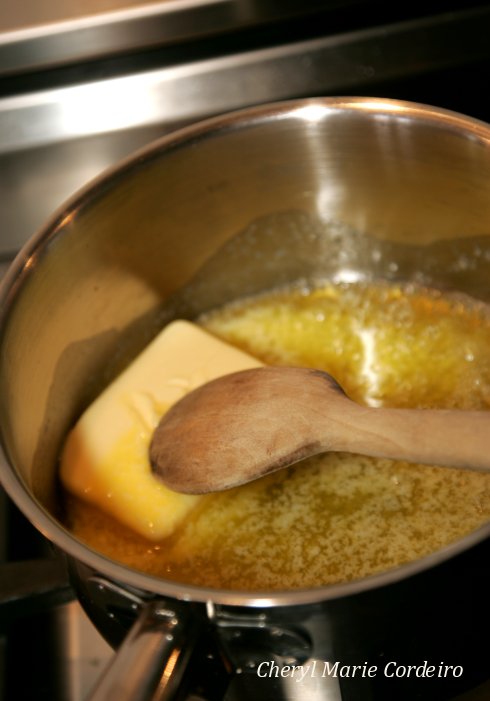
Melting butter for cinnamon rolls or kanelbullar.

Melting the butter – the first step in making Cinnamon Rolls.

The Swedish fika, which translates to ’coffee break’ was an activity whose local ritualistic implications dawned on me only gradually, beginning actually with my attendance at late evening seminars at the university whilst pursuing my doctorate degree.

I came to know these research seminar sessions (often held as one large fika) as ’cheese parties’ because the group of us attending these meetings would gather around a table in the seminar room, pass around buns, fruit, sandwiches, coffee, tea and sometimes red or white wine, discussing the most current research in the field, its challenges and how to move ahead in our projects,

As a side issue, I often wondered if these sessions were actually useful, since too many opinions might derail you rather than help you focus, but in hindsight I think they were both pleasant and valuable, and that my favourite ones were those where our creative spirits and constructive criticism were fueled by one or two glasses of wine to go with the cheese.

Kneading the dough.

Kneading the dough is a pleasant pass time that takes very little effort. Some soft kneading where you calmly let the springy gluten threads develop is all it takes.

And what is current at some fika sessions at work today are Corporate Social Responsibility (CSR) and Sustainable Development, where one aspect of is the social well-being and welfare of employees – how can Swedish leadership create (and sustain) a working environment that nurtures creative innovation, etc.

Melted butter onto the dough.

Melted butter on the dough, just before the cinnamon and sugar goes on.

Hembakade kanelbullar, fikabröd.

Cinnamon Rolls, fikabröd.

And the Swedish fika, together with its fikabröd, one of which is the cinnamon roll, is focal in these discussions because all of these issues are currently being discussed, over coffee. No doubt the Swedish fika is one of the key ingredients of what makes the Swedish management style unique.

Awaiting this theory to be confirmed in some scientific paper, Cinnamon Roll day in Sweden is upcoming in about 2 weeks and I for one, am already looking forward to seeing lots of these at the upcoming fika sessions at work, improving as it were, both creativity and the Swedish Management style.

When failure is success: a change of view in expatriate integration

The job of the expatriate in international job transfers is hardly an easy transition. Most Scandinavian expatriate contracts in Singapore for example average 3 years, during which time, the employees, usually at managerial level, are supposed to make adjustments along several dimensions, both in the private and public domains.

International managers not only need to adjust to a new home, perhaps a new language, and new schools for the children if the family is in tow, but they are also expected to adjust into the new role within the organization and perform on the job.

If the ballpark figure is given at about a year to adjust to a foreign environment, then 3 years for the average expatriate contract, isn’t much time given to get things working smoothly, since as soon as you begin to feel comfortable in the new environment, it’s time to go home. Going home is not also always smooth sailing since you’re perhaps faced with a host of re-acculturation issues due to that you have gained new knowledge from the new environment and now cannot help but apply that new knowledge back home.

During the 1960s and up until about ten years ago, the majority body of literature that governed relocation and expatriate managers’ experience overseas equated their transition success with how far they’ve come to be integrated with the host country’s culture (Black, 1988; Janssens, 1995)

In speaking with Scandinavian respondents about their experience in socializing with Singaporeans, many of them mentioned that they felt marginalized and not at all integrated into the Singapore society. It didn’t seem to matter whether they were there for three years or in some cases, fifteen to twenty-six years. Disheartened and feeling not quite successful in the aspect of cross-cultural socializing, many said they felt ‘outside’ of the local system, some even mentioning that they felt more ‘Swedish’ or ‘Danish’ when they were in Asia, than when they were back in Scandinavia.

When it came to cross-cultural socializing, the organizations had office functions and staff dinner and dances, which they found a perfect opportunity to mingle with the locals, but apart from such events, they found themselves rarely socializing with the locals.
Continue reading ”When failure is success: a change of view in expatriate integration”

The beginnings of profiling Scandinavian leaders in Asia: the 6 categories

juxtaposed_cities

The experience of being and working in a foreign city is like a juxtaposition of realities. It’s difficult not to impose what you already know from before, to the here, now and the Other. Photo by Doug Keyes, from his Becoming Language series.

In 2004, I had the opportunity to network and meet up with about 33 Swedish leaders (CEOs, MDs, regional managers, managers etc.) and their Asian counterparts. They all worked in Swedish related or Swedish owned organizations in Singapore, some of which being Ikea (I think almost all Singaporeans have something from Ikea these days, they have just opened a 2nd megastore on that tiny city island!), Sony Ericsson, Kvaerner E&C and ASSAB. Continue reading ”The beginnings of profiling Scandinavian leaders in Asia: the 6 categories”