Text and Photo © 2026 CM Cordeiro
It is not every day that a seminar room fills with the kind of quiet intellectual energy that makes you reach for your notebook before the speaker has even begun. Last week’s gathering at the University of Gothenburg, organised by CERGU (Centre for European Research) and CIBS (Centre for International Business Studies), School of Business, Economics and Law, was one of those occasions.
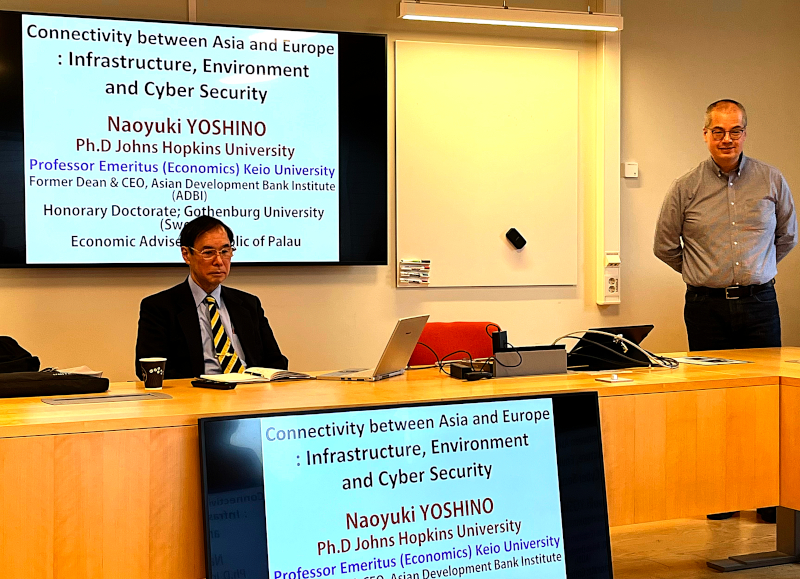
The guest of honour was Professor Emeritus Naoyuki Yoshino of Keio University, Tokyo, a Johns Hopkins-trained economist whose career spans monetary policy, infrastructure finance, green finance, and most recently, cyber security governance. Professor Yoshino holds an honorary doctorate from the University of Gothenburg, making this visit a homecoming of sorts, and has served as Dean and CEO of the Asian Development Bank Institute (ADBI). He is also Economic Adviser to the Republic of Palau.
His seminar covered three interconnected themes.
Infrastructure Financing and EU-Asia Financial Connectivity
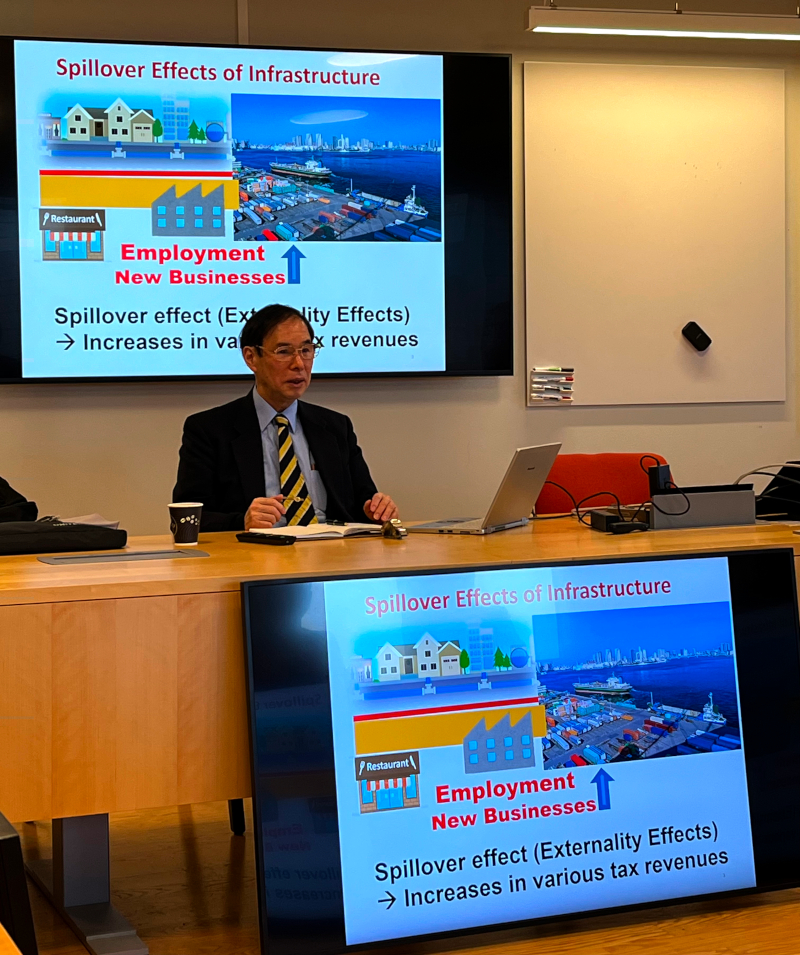
Professor Yoshino opened with the economics of infrastructure investment, a subject he has spent decades refining. His central argument is elegant: public infrastructure generates spillover effects well beyond the project itself, creating new employment, attracting new businesses, and ultimately raising tax revenues for governments at multiple levels. These spillover tax revenues, he argues, can and should be structured as a financing mechanism, attracting private investors with a steady, long-term income stream tied to the economic activity that infrastructure unlocks. Applied to the EU-Asia connectivity agenda, this framework offers a compelling alternative to purely aid-based or loan-based models of cross-regional infrastructure development.
Green Finance
The second theme drew a direct line between infrastructure investment and environmental responsibility. Using a clean production function, where both economic output and CO₂ emissions are jointly produced by labour and capital, Professor Yoshino illustrated the inescapable tension at the heart of development finance: growth and carbon are not yet decoupled. Green finance instruments, including green bonds and ESG-linked investment frameworks, were examined critically, with a note of caution about the risk of portfolio distortion when ESG definitions vary across institutions.
Cyber Security
Perhaps the most forward-looking part of the seminar addressed cyber security, specifically the absence of a coherent global reporting and governance structure for cyber incidents. Drawing parallels with international financial regulation, Professor Yoshino made the case for a shared multilateral framework, one that would allow governments, financial institutions, and infrastructure operators to report, monitor, and collectively respond to cyber threats across borders. In an era of deepening digital infrastructure dependency, this is not a technical problem alone. It is a governance challenge of the first order.
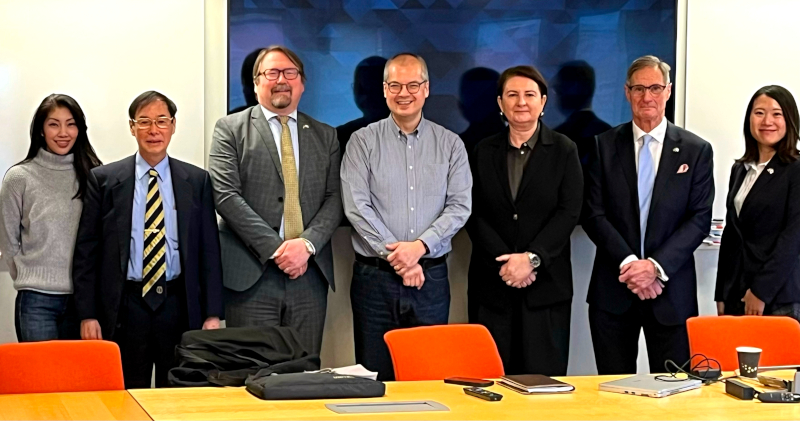
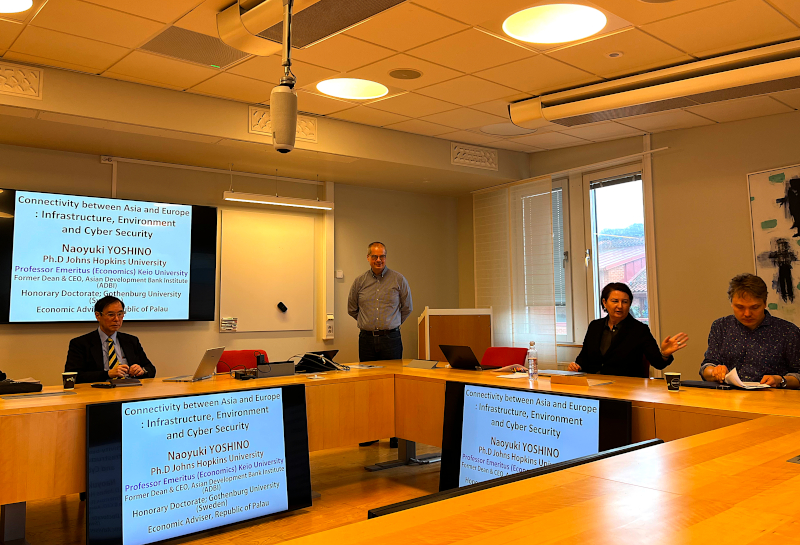
The seminar was moderated with characteristic precision by Dr. Richard Nakamura, Associate Professor at CIBS. Also present were Dr. Andrea Spehar of CERGU and Dr. Patrik Ström, Director of the European Institute of Japanese Studies at the Stockholm School of Economics, scholars whose work at the intersection of European and Asian affairs added depth to the afternoon’s conversations. The event also brought together Ms. Eriko Aono (Hayashi) of the Embassy of Japan, Honorary Consul General of Japan in Gothenburg Mr. Peter Forssell, and a warm gathering of colleagues and friends.
For me, the afternoon carried an added layer of meaning. Alongside the intellectual richness of the seminar itself came the rather surreal pleasure of reconnecting with colleagues I have known since 2009. Dr. Patrik Ström, my former Head of Department at the University of Gothenburg, and Dr. Richard Nakamura, who moderated the session with easy command, were both present. Seeing familiar faces in a room shaped by ideas we have all, in different ways, spent years working around was one of those quietly grounding moments that academic life occasionally offers. Sixteen years go quickly.
Three themes. One afternoon. A reminder of why cross-disciplinary, cross-regional dialogue, between economists, policymakers, and researchers, remains essential.
Thank you, Professor Yoshino. And thank you to the organisers and hosts for making this afternoon in Gothenburg one to remember.