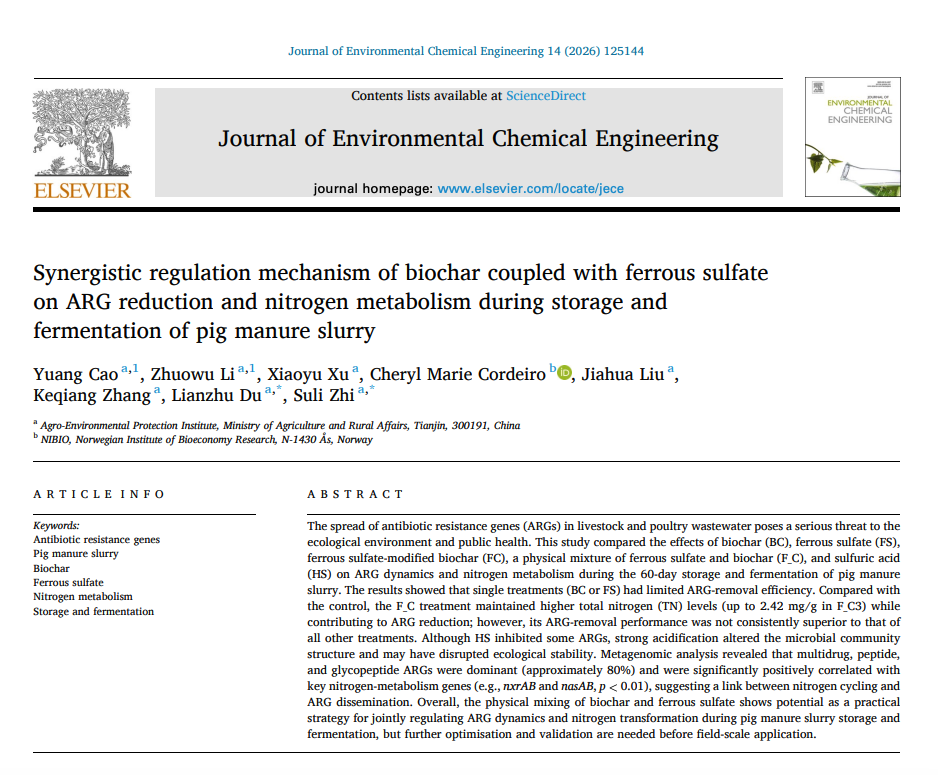
How can livestock manure be managed so that its nutrients remain useful while the risks associated with antibiotic resistance are reduced? Our newly published article in the Journal of Environmental Chemical Engineering explores this question through the storage and fermentation of pig manure slurry (Cao et al., 2026).
The study examines the combined use of biochar and ferrous sulfate, bringing together two concerns that are central to circular nutrient management: the fate of antibiotic resistance genes and the transformation of nitrogen. I am pleased to share this publication with colleagues Yuang Cao, Zhuowu Li, Xiaoyu Xu, Jiahua Liu, Keqiang Zhang, Lianzhu Du and Suli Zhi.
Storage as an opportunity for intervention
Manure slurry contains nitrogen that can support agricultural production. It can also carry antibiotic resistance genes (ARGs), the genetic information that can enable microorganisms to resist antibiotics. The period before land application is therefore an important part of manure management. During storage and fermentation, changes in microbial communities and slurry chemistry can influence both nutrient availability and the persistence of resistance genes.
Our study focused on this stage using slurry collected from a pig farm in Tianjin, China. A 60-day laboratory experiment compared 13 treatment groups, with three replicate reactors per treatment, at approximately 30 °C. The treatments included biochar, ferrous sulfate, ferrous sulfate-modified biochar, physical mixtures of biochar and ferrous sulfate, and sulfuric acid, alongside an untreated control. Chemical measurements and metagenomic analysis were used to examine nitrogen forms, microbial communities and resistance-gene profiles.
Balancing resistance-gene reduction and nitrogen retention
The physical mixture of biochar and ferrous sulfate showed promising combined performance. Compared with the control, it contributed to ARG reduction while maintaining higher total nitrogen levels. However, it did not consistently outperform every other treatment in ARG removal (Cao et al., 2026).
This distinction matters when evaluating a treatment for nutrient recovery. Its usefulness depends on several outcomes together: which resistance genes persist, how nitrogen changes, and how the microbial community responds. Biochar or ferrous sulfate used alone had limited ARG-removal efficiency. Sulfuric acid inhibited some ARGs, but strong acidification also changed the microbial community and raised questions about ecological stability.
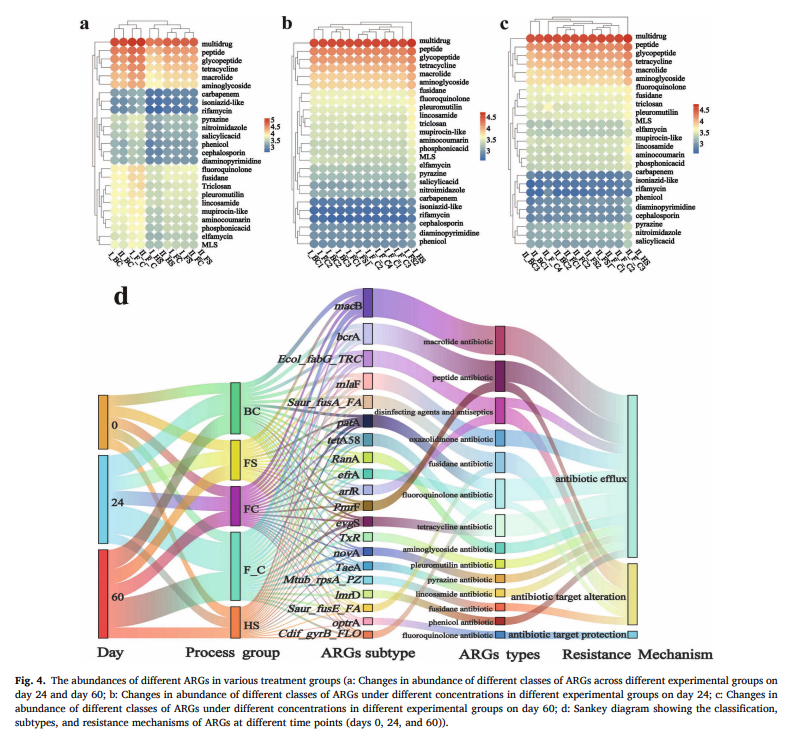
The results also show why individual gene responses deserve attention. Some resistance genes remained abundant across treatments, and particular genes increased under certain conditions. A favourable overall treatment response should therefore be interpreted alongside the detailed resistance-gene profile.
Understanding the links with nitrogen metabolism
Metagenomic analysis identified associations between resistance genes and genes involved in nitrogen transformations. These patterns suggest that nitrogen cycling and ARG dynamics may respond to shared environmental conditions and microbial communities.
They do not establish that one process directly causes the other. Factors such as pH, nutrient availability and redox conditions may influence both. Similarly, adsorption by biochar, iron-related redox reactions and changes in microbial communities provide plausible explanations for the combined treatment’s effects, but their individual contributions require further testing. Horizontal gene transfer and direct ARG degradation were not established as causal mechanisms in this experiment.
Implications for circular nutrient management
For me, the broader significance lies in evaluating nutrient recycling together with the quality of the material being returned to agriculture. Retaining nitrogen is valuable, and understanding the accompanying microbial and resistance-gene dynamics helps make that assessment more complete.
The physical mixing of biochar and ferrous sulfate offers a direction for further research. Moving towards practical application will require optimisation of treatment conditions, further statistical validation and field-scale testing. The present findings provide a basis for that work, while keeping the limits of a controlled laboratory study in view.
My contribution to this collaborative publication was writing, review and editing. I am grateful to the team for the opportunity to contribute to research connecting manure treatment, environmental microbiology and circular nutrient management.
Reference
Cao, Y., Li, Z., Xu, X., Cordeiro, C. M., Liu, J., Zhang, K., Du, L., & Zhi, S. (2026). Synergistic regulation mechanism of biochar coupled with ferrous sulfate on ARG reduction and nitrogen metabolism during storage and fermentation of pig manure slurry. Journal of Environmental Chemical Engineering, 14(6), Article 125144. https://doi.org/10.1016/j.jece.2026.125144