Reduced fertiliser inputs: Managing antibiotic resistance genes along the soil-root-crop continuum
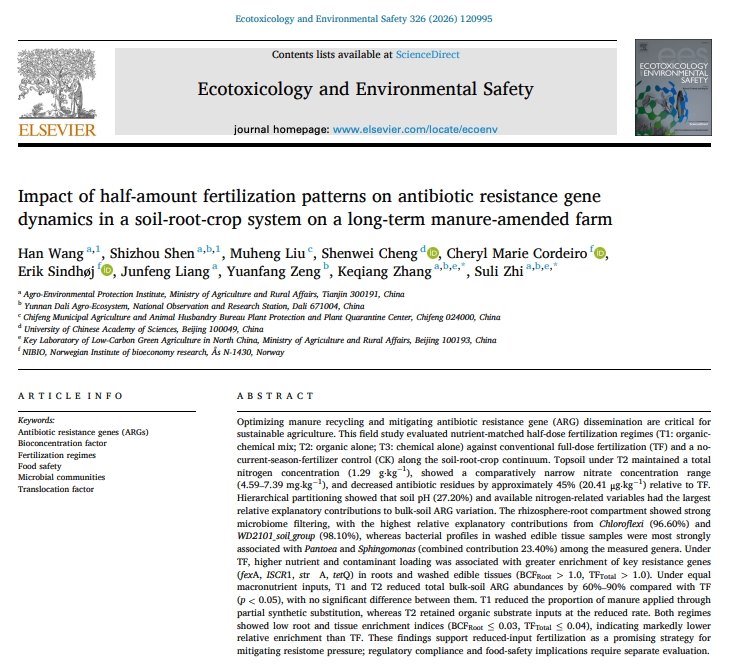
How can manure nutrients be returned to agricultural soils while reducing the accompanying pressure from antibiotic resistance genes? Our newly published article in Ecotoxicology and Environmental Safety examines this question through a field experiment comparing fertiliser sources and application rates in a Chinese cabbage cropping system (Wang et al., 2026).
The study brings together two concerns central to circular nutrient management: maintaining soil nutrient resources and understanding the environmental consequences of repeated manure application. I am pleased to share this collaborative publication with colleagues Han Wang, Shizhou Shen, Muheng Liu, Shenwei Cheng, Erik Sindhøj, Junfeng Liang, Yuanfang Zeng, Keqiang Zhang and Suli Zhi.
From manure recycling to field management
Manure provides organic matter and nutrients that support agricultural production. It can also introduce antibiotic residues, antibiotic resistance genes (ARGs) and other contaminants into soil. Repeated applications influence both the substances entering the field and the conditions in which soil microbial communities develop.
This makes fertiliser management an important point of intervention. Alongside improving manure treatment before application, there is a need to understand how the amount and composition of fertiliser affect resistance-gene patterns once nutrients reach the soil.
Our study examined these relationships on a pig farm in Tianjin, China, during the growing season from August to November 2022. The field had a history of annual manure application, providing a setting in which to investigate reduced inputs against a background of previous nutrient and contaminant loading.
Comparing fertiliser amounts and sources
The experiment compared conventional full-rate fertilisation with three reduced-input regimes: a mixture of organic and chemical fertilisers, an organic-based regime, and a chemical-fertiliser regime. A fifth treatment received no additional fertiliser during the experimental season.
The three reduced-input regimes received the same nominal nitrogen, phosphorus and potassium inputs, each at half the conventional rate. This allowed comparisons of fertiliser-source composition within a common nutrient-input level. Supplementary mineral phosphorus and potassium were used to match these inputs, so the organic-based treatment should not be interpreted as a certified organic farming system.
Measurements covered bulk soil at three depths, soil closely associated with roots, surface-sterilised roots, and washed edible stems and leaves. Together, these compartments provided a view of resistance-gene patterns along the soil-root-crop continuum.
Lower resistance-gene abundance under reduced inputs
The reduced mixed and organic-based regimes showed substantially lower total abundance of the targeted resistance genes in bulk soil than conventional full-rate fertilisation. Reductions were approximately 60 to 90%, with no statistically significant difference between these two reduced-input approaches (Wang et al., 2026).
The organic-based reduced-input treatment also showed approximately 45% lower measured antibiotic residues than the conventional treatment. Its topsoil total nitrogen concentration was 1.29 g/kg, compared with 1.76 g/kg under conventional fertilisation.
These findings suggest that reducing inputs can moderate manure-associated resistance-gene pressure while retaining measurable soil nutrient resources during the growing season. However, soil nutrient concentrations alone do not establish that crop yield, quality or longer-term fertility will be maintained. Those outcomes require further agronomic assessment.
Soil conditions and microbial communities matter
Fertiliser management changes more than the quantity of nutrients supplied. It also influences soil chemistry and the microbial communities associated with soils and plants.
In bulk soil, statistical analysis identified soil pH and nitrogen-related variables as important factors associated with resistance-gene variation. Closer to and within roots, microbial community composition became particularly relevant. Different bacterial groups were associated with resistance-gene patterns in the washed edible tissues.
These results point to the importance of examining each compartment separately. Bulk soil, the root environment and crop tissues offer different conditions for microorganisms, and their resistance-gene profiles need not respond in the same way.
The observed associations do not establish which bacteria carried particular resistance genes or demonstrate horizontal gene transfer. They help identify relationships for further investigation.
Interpreting the crop-associated findings
Conventional full-rate fertilisation was associated with greater relative enrichment of several targeted genetic markers in roots and washed edible tissues. The reduced mixed and organic-based treatments showed much lower comparative enrichment indices.
This is a promising result, but the meaning of these indices needs to remain clear. They describe gene abundance relative to another sampled compartment; they are not validated food-safety thresholds.
Similarly, detecting resistance-gene DNA does not establish the presence of viable resistant pathogens or demonstrate transmission to people. The edible stems and leaves were washed but were not surface-sterilised using the root protocol, so their results represent tissue-associated genetic material rather than confirmed internal colonisation.
The study therefore provides evidence of lower relative enrichment under reduced inputs, while leaving direct food-safety implications for separate evaluation.
Implications for circular nutrient management
For me, the broader significance lies in connecting nutrient recycling with the management of the receiving soil. The environmental performance of manure reuse depends on treatment, application rate, fertiliser composition and the history of the field.
The two promising reduced-input regimes also represent different management choices. Partial substitution with chemical fertiliser reduced the proportion of manure applied in the mixed treatment, whereas the organic-based treatment retained organic inputs at a lower loading rate. Both were associated with lower soil resistance-gene abundance than conventional full-rate fertilisation.
The findings come from one site, one crop and one growing season, with three replicate plots per treatment. The unfertilised control also retained the legacy of earlier manure applications. Multi-season trials across different soils and cropping systems, combined with crop-yield, quality and economic assessments, will be needed before wider recommendations can be made.
My contribution to this publication was writing, review and editing, and visualisation. I am grateful to the team for the opportunity to contribute to research that connects fertiliser management, environmental microbiology and the responsible recycling of agricultural nutrients.
Reference
Wang, H., Shen, S., Liu, M., Cheng, S., Cordeiro, C. M., Sindhøj, E., Liang, J., Zeng, Y., Zhang, K., & Zhi, S. (2026). Impact of half-amount fertilization patterns on antibiotic resistance gene dynamics in a soil-root-crop system on a long-term manure-amended farm. Ecotoxicology and Environmental Safety, 326, Article 120995. https://doi.org/10.1016/j.ecoenv.2026.120995