Yield-efficiency trade-offs in pelleted recycled nutrient fertilisers: Why nitrogen accounting matters
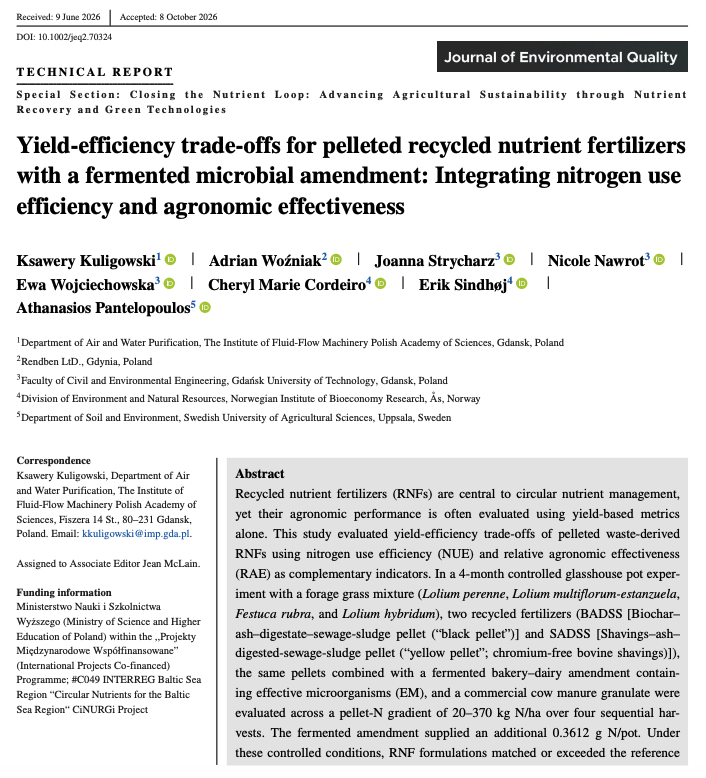

Can a recycled nutrient fertiliser that delivers high yields also be described as efficient? Our newly published technical report in the Journal of Environmental Quality addresses this question by evaluating pelleted, waste-derived fertilisers through nitrogen use efficiency (NUE) and relative agronomic effectiveness (RAE) alongside biomass yield (Kuligowski et al., 2026).
The article appears in the journal’s special section Closing the Nutrient Loop: Advancing Agricultural Sustainability through Nutrient Recovery and Green Technologies. I am pleased to share this collaborative publication with colleagues Ksawery Kuligowski, Adrian Woźniak, Joanna Strycharz, Nicole Nawrot, Ewa Wojciechowska, Erik Sindhøj and Athanasios Pantelopoulos.
Why yield alone is not enough
Recycled nutrient fertilisers (RNFs) are central to closing urban-rural nutrient loops and reducing dependence on fossil-derived mineral fertiliser. Their agronomic performance, however, is often judged by yield alone. A fertiliser can produce high biomass while recovering only a small share of the nitrogen applied, leaving surpluses that may be lost to the environment.
NUE and RAE offer complementary perspectives. NUE describes the proportion of applied nitrogen taken up by the crop, linking productivity to nutrient recovery. RAE expresses crop response relative to a reference fertiliser, allowing recycled products to be compared with conventional materials. Considered together, the two indicators distinguish fertilisers that achieve high yields through efficient nutrient use from those that rely on high nutrient inputs to sustain productivity.
Waste-derived pellets and a fermented amendment
Two base pellets were produced from locally available waste substrates: fish-processing waste, digested sewage sludge and biomass ash, combined with either biochar (BADSS, the ”black pellet”) or chromium-free bovine shavings from leather manufacture (SADSS, the ”yellow pellet”). Each pellet was also tested together with a fermented bakery-dairy amendment containing effective microorganisms (EM). A commercial cow manure granulate served as the organic reference fertiliser.
In a four-month glasshouse pot experiment in Pomerania, northern Poland, the fertilisers were applied to a forage grass mixture of Lolium perenne, Lolium multiflorum-estanzuela, Festuca rubra and Lolium hybridum at pellet-nitrogen rates equivalent to 20 to 370 kg N/ha. Biomass was harvested four times. Chlorophyll fluorescence indicators of photosystem II performance were measured alongside residual soil pH, electrical conductivity and redox potential.
Higher yields, lower proportional nitrogen recovery
Under these controlled conditions, several recycled fertiliser formulations matched or exceeded the cow manure reference in cumulative biomass. SADSS combined with the fermented amendment (SADSS+EM) produced the largest yield responses and RAE values.
NUE, by contrast, declined strongly as nitrogen input increased. Higher productivity did not necessarily coincide with higher proportional nitrogen recovery, revealing a clear yield-efficiency trade-off. Non-amended SADSS showed the most balanced relationship between RAE and NUE across the application gradient, consistent with better synchronisation of nitrogen supply and plant demand within the pot system.
Photochemical measurements indicated that photosystem II function was largely preserved under the tested conditions. Treatment differences in productivity were associated mainly with nitrogen acquisition and regrowth dynamics, while photochemical responses were secondary.
Accounting for every nitrogen input
A central methodological lesson concerns the fermented amendment itself. It supplied an additional 0.3612 g N per pot, together with organic material and other constituents. When only pellet nitrogen was used in the calculation, NUE for the amended treatments exceeded 100% at several low application rates. Once amendment-derived nitrogen was included, calculated NUE fell substantially. Apparent performance gains therefore reflected both co-supplied nutrients and treatment-specific interactions.
Because no nutrient-matched carrier control was included, the experiment supports a formulation-level response to the amendment rather than a microorganism-specific causal effect. This distinction matters for how biologically enhanced recycled fertilisers are evaluated and communicated.
Implications for circular nutrient management
Personally, it seems the broader significance lies in transparent system boundaries. Nutrient recycling contributes to circularity when recovered nutrients are used efficiently by crops. Fertilisers that deliver high yields with low nitrogen recovery may increase nutrient surpluses, loss risks and cumulative contaminant loading, even when derived from recycled sources. Integrating NUE and RAE, with all nutrient inputs accounted for, gives a more realistic assessment than yield alone.
The findings come from a four-month pot experiment under controlled glasshouse conditions. Field validation across soils, climates and cropping systems, combined with direct measurement of nutrient losses and microbial processes, will be needed before operational fertiliser or environmental recommendations can be made.
The study was carried out within the CiNURGi (Circular Nutrients for the Baltic Sea Region) project, funded by the EU Interreg Baltic Sea Region Programme, with national co-financing from the Polish Ministry of Science and Higher Education under the ”Projekty Międzynarodowe Współfinansowane” (International Projects Co-financed) programme. My contribution to this publication was conceptualisation, methodology, validation, and writing, review and editing. I am grateful to the team for the opportunity to contribute to research that connects nutrient recovery, fertiliser evaluation and circular nutrient management in the Baltic Sea Region.
Reference
Kuligowski, K., Woźniak, A., Strycharz, J., Nawrot, N., Wojciechowska, E., Cordeiro, C. M., Sindhøj, E., & Pantelopoulos, A. (2026). Yield-efficiency trade-offs for pelleted recycled nutrient fertilizers with a fermented microbial amendment: Integrating nitrogen use efficiency and agronomic effectiveness. Journal of Environmental Quality, 55, e70324. https://doi.org/10.1002/jeq2.70324