Malted oat cookies and the concept of Flow

Malted oat cookies.
Text and Photo © JE Nilsson, CM Cordeiro 2013

Sunday afternoons are the perfect occasions for reflection and relaxation and my favourite occupation at such times is to bake something. Maybe to enjoy with the afternoon fika at home or maybe to share with my office colleagues by Monday depending on the amount of damage control needed to let the remainder look good.

Today my thoughts as always covered a wide circle, making pit stops at such seemingly disparate topics as the ASEAN countries free world trade negotiations, the ongoing election in Italy and the joint Volvo Geely research centre that is being planned, ongoing events that in part shape the world we are all living in.

The common denominator was the question of human innovation and motivation, as covered by Professor of innovation knowledge, Bengt Järrehult in a recent article. As I see it, nothing is given and we are all part of the process in which we all create the future together, step by step and by our own choices.
Continue reading ”Malted oat cookies and the concept of Flow”

There is [increasingly] no spoon

Keanu Reeves in the science fiction-action movie The Matrix (1999).
The small boy is played by
Uri Geller. Or not.

Admittedly, I like broad sweeps and this is going to be one of the broader that I take. But please bear with me. We’ll eventually be back to the bar of single origin Ecuadorian dark chocolate. Promise.

First we will need to go back a little bit in time to a scene in the 1999 movie, The Matrix, where a little boy flexes a spoon, bending it at will. He then looks up and says, ”There is no spoon”.

Now, that is a point of view I will try to demonstrate that is increasingly worth being considered. Continue reading ”There is [increasingly] no spoon”

Complex systems theory and the biological organization

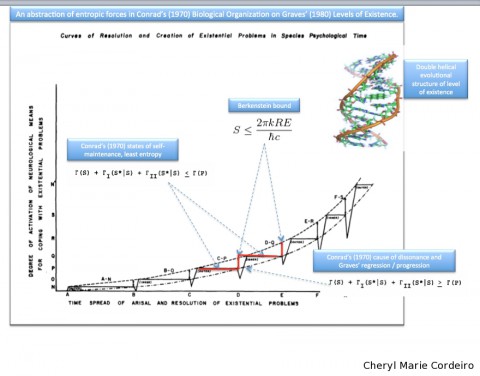
An abstraction of Michael Conrad’s (1970) Biological Organization on Clare W. Graves’ (1980) Levels of Existence.
Text and Photo © CM Cordeiro 2013

In reading about self-organizing structures for the relevance of theory applied to the field of international business (IB), I thought the ideas expressed by Michael Conrad in his paper entitled, Statistical and Hierarchical Aspects of Biological Organization (made accessible via NASA) was interesting when also applied to the theoretical constructs of Clare W. Graves’ Levels of Existence.

Conrad discusses the differentiation and uncertainty associated with the organization and variability in a biological organization’s compartmental structures, that are expressed in terms of certain entropy measures. In his paper, he tries to ascertain the most efficient operative level of a biological system, landing on the principle of static equilibrium that he uses vector models for representation. Continue reading ”Complex systems theory and the biological organization”

Lateralizing of influence between states as a means of preserving power

The evening’s contemplation… the opening paragraph of Joergen Oerstroem Moeller’s article, “Economic Integration: the Future for Asia” in the Diplomatist’ special issue published on the occasion of the ASEAN-India mid-December 2012 meeting in New Delhi.



His article addresses what in my view is the need for a heterarchous organizational structure in state / regional governance, as a system to manage heterochronous developments within and between states. Where and how heterarchy can be effectively accomplished and operationalizable is a discussion point.

Throughout his numerous articles, Moeller’s perspective is consistent – lateralization of decision-making may on the outset seem a dissipation of power, but in reality, it could be the only way to preserve power. What is perhaps needed is a re-conceptualization of ‘power’ in the contextual understanding and recognition that the world shares one destiny.

“Over the last half century economic transactions have jumped out of the nation-state box and take place globally, while the political systems put in place to control economic activities are still mainly national and domestic. This schism between international economic transactions and national political systems exposes the impotence of policy-making and thereby undermines the legitimacy of the political system in the eyes of the citizens. This spills over into skepticism about the advantages of economic globalization. The choice for politicians is to share decision-making with other nation-states or to lose influence, which is difficult to explain as it looks as giving away powers while in fact it is the only way to preserve power.” ~ J.O. Moeller, 2012.

Joergen Oerstroem Moeller is Senior Fellow, Singapore Ministry of Foreign Affairs, Diplomatic Academy. He was former Danish Ambassador to Singapore, Brunei Darussalam, Australia and New Zealand. He is also author to one of my favourite reads, How Asia Can Shape the World -From the Era of Plenty to the Era of Scarcities (2011, ref. video panel discussion of the book at SMU Singapore, chaired by Kishore Mahbubani).

On managing heterochronous developments in Singapore


Attilio Rapisarda:

Hi Cheryl,

Interesting article: thanks!

I am very interested in learning about the reasons why people in service & knowledge-based societies are reluctant to marry and have children.

I believe that a fundamental reason is the changing economic value of children: from assets to liabilities.

In rural societies, children were ”energy”. In our modern societies, children not only start being productive increasingly later in life but are also less willing to provide for their elderly parents. Labour markets’ demand for ”flexibility” also means that children find it harder to be physically close and economically solid enough to serve their ”filial piety” corvée. Some people will find that the wish to have children should not be based on economic incentives and should rather be based on ”love”.

Still, as you have pointed out in your article, having children for ”love” is a relatively recent idea in our history. Traditionally, political or economical reasons based the decision for marriage and children. Also, although humans are certainly capable of acts that transcend individual interests, they generally are driven by the satisfaction of practical needs, just like any other mammal: food, shelter, accumulation of resources.

I think that such shift on how children are perceived – from ”asset” to ”liability” – reflects a reality that is more certain, stable and lasting for potential parents than any of the incentives the Singaporean government is currently proposing. For this, I believe such incentives are destined to failure.

I wonder whether we are in a situation of ”heterochrony”: two systems – the productive system and the reproductive system – that evolve at different speeds. The societal forms subserving the reproductive system evolve at a much slower pace and we are now stuck with forms of marriage and family that fit the rural productive system but not the knowledge-based one.

Continue reading ”On managing heterochronous developments in Singapore”

A multifractal system perspective of culture in international business

A plot of a multifractal wavefunction at the Anderson transition in 3D can be found as Fig. 1 of Vasquez, Rodriguez, and Roemer’s (2008), ”Multifractal analysis of the metal-insulator transition in the 3D Anderson model I: Symmetry relation under typical averaging”. arXiv:0807.2217v1 [cond-mat.dis-nn]:

Coming from a social sciences background and continuing in the line of transformative theories, I could liken the wave particle duality to researcher’s interference, where the act of observing would in itself render a certain bias to the data collected and observed phenomenon simply because the observer becomes an entity to be considered in that which is being investigated and studied. Related then to this uncertainty principle is how in the field of international business, the concept of culture which is one of the most sensitive of concepts to be influenced by researcher perspective, where each researcher embodies his/her own values and belief systems, continues to be dominated by the western cultural dimensions construct in an era of increasing globalization and of advancing information communication technologies that render a blurring to traditional geographical boundaries. Social media platforms for example create an entirely new type of virtual landscape, bringing together people from different parts of the world, with different languages, values and beliefs.

Jason Padgett’s wave particle duality.

It is to this extent that culture, that has thus far been studied as national averages and have had differences as a measurement of complementarity in the success or failure of a foreign enterprise entries, should perhaps be re-conceptualized in terms of a fuzzing of boundaries to include a multi-levelled perspective that works across groups of individuals that share a common motivation system, regardless of nationality for example.

It is in this light that the multifractal system to the study of culture in international business might cast light beyond the Yin Yang concept of culture, where the latter eastern perspective of culture, if not taken in its original sense from the book of I-Ching (Book of Changes), of being an infinite system of duality, but reduced to simply duality of properties, would further contribute to a dichotomous point of view of the theory of culture i.e. if not west then east.

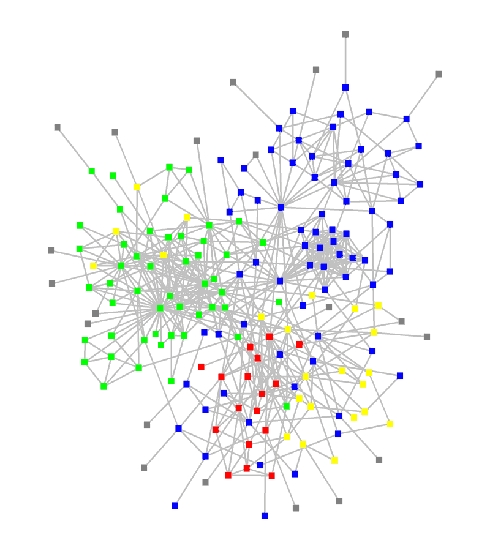
Social Network Visualisation: e-mail between the members of a project. Every square depicts a participant. Its colour indicates which departments he/she belongs to. Grey lines indicate that there’s at least a weekly frequency between the two linked participants. Source: Orgnet.com; Infovis.net.

Groups of social networks for example, regardless of national boundaries, may exhibit similar values and belief systems in a complex spatial structure much like those found in social networking theories, where individuals are characterized by not just a single (i.e. nationality or race for example) independent characteristic value but rather a set of values that belong to different contextual ”multifractal” backgrounds through a space-time dimension.

Transformative theories – when international business can benefit from quantum mechanics

Jason Padgett and Q.A.T

Pictures from Jason Padgett and Q.A.T.
Text and Photo © CM Cordeiro 2012

An evening thesis:

Beyond the eastern Yin Yang perspective of culture, visually represented above in a metaphoric nomogram, is the concept of a pluralistic, aperspectival view of the concept of Multiculturalism, that to some extent, I would liken to the “most favoured nation” (MFN) clause following bilateral trade agreements in the norms of GATT and WTO, which is that of reciprocity and non-discrimination. What I find interesting in these visual representation from quantum mechanics is how the aperspectival fallacy often referred to as “aperspectival madness” is negated / neutralized via a heterarchial construct – an organizational construct deemed most advanced and most difficult to achieve, that I would to some extent, liken to multilateral trade agreements in international trade and a true understanding of Multiculturalism that encompasses the reductionistic view of the Yin Yang concept, though not vice versa.

Bibliography
Van Den Bossche, P. 2008. The Law and Policy of the World Trade Organization, Text, Cases and Material, 2nd edition. Cambridge.

The Yin Yang theory, a non-confrontational approach to culture

Me, together with Professor Tony Fang, Stockholm University, School of Business. As I am right now working on a collaborative research project with Professor Fang, it was nice to listen in on his guest lecture at the Department of Applied IT, at the University of Gothenburg and Chalmers University of Technology.
Text and Photo © JE Nilsson and CM Cordeiro 2012

Tony Fang, who is Professor of Business Administration at Stockholm University, gave a guest lecture today at the Department of Applied Information Technology (IT), on his concept of a Yin Yang perspective to culture. In today’s Internet culture, where collaborative work can be done through Dropbox, Skype and via emails, that he was in Gothenburg proved a good opportunity for us to meet in person. Continue reading ”The Yin Yang theory, a non-confrontational approach to culture”

Managing complexities, extending Singapore’s national defense strategy of ”auftragstaktik” to its socio-cultural fabric

Cheryl-Marie-Cordeiro-by-Alen-Cordic-2012-1581I read with interest, Peter Ho’s RSIS working paper no. 248 on “Governing for the future: what governments can do”.

It is a paper based on an adaptation of his speech delivered at the Australia-New Zealand School of Government (ANZSOG) Annual Conference 2012 in Wellington, New Zealand on 26 July 2012. Mr. Peter Ho is Senior Advisor to the Centre for Strategic Futures and Senior Fellow in the Civil Service College. He serves as an Adjunct Professor with the S. Rajaratnam School of International Studies. He is a Senior Fellow of the Lee Kuan Yew School of Public Policy, and was formerly the Head of the Civil Service in Singapore.

In brief, Ho outlined in his paper, how accelerating changes in the 20th century, for example such as population growth, rapid urbanisation in combination with technological innovation has come to result in complex interconnected environments that in turn give rise to unpredictable trajectories and “wicked problems” (Horst and Webber, 1973) or interesting problems that have no immediate / obvious solution.

Globally, there are many international diplomatic talks that revolve around ”wicked problem” issues such as climate change, food, water and energy supply, all preferably within a sustainable economic development framework. At a local level in Singapore, Ho cited the example of the complex nature of extremist religious pursuits that led to the need for new warfare strategies that counter forces both material and cognitive in order to keep the nation secure and how Singapore was under the constant challenge to disarm extremist ideologies.

But whether facing global political-economic environmental changes or ideological extremism, Ho’s point was governments that have the agility and capacity to act swiftly in such circumstances will benefit and thrive in today’s complex environments. And my perspective is that it is in this aspect that Singapore’s regional geo-political position and albeit seemingly contradictory socio-economic policies have most of the time benefited the country and its people on multiple levels.

As a national security strategy in coordinating counter-terrorism for example, Singapore has continuously worked towards and adopted a multi-layered, integrated and holistic “Whole-of-Government” (WOG) approach, leveraging on the diverse strengths of existing agencies and ministries at various levels from strategy and policy to operations.
Continue reading ”Managing complexities, extending Singapore’s national defense strategy of ”auftragstaktik” to its socio-cultural fabric”

Gödel’s theorem and executive education: reflections from the Chinese automobile industry’s strategy in talent management

Part of what makes being in academia so exciting for me is the very incompleteness of each project as expressed in Gödel’s theorem [1], here not referring strictly to its origins in mathematical logic of incomplete axiomatic systems, but rather used in a general linguistic sense of how research by definition, lies in a perpetual state of unfinish, the completion of which would warrant it redundant.

It is this continuous dialogic and dialectic process of thought, creativity and innovation of ideas, a journey that continuously reveals and uncovers what was previously obscure or even unknown that I find oddly comforting – finding familiarity in the unfamiliar, a constant in the flux of things.

As part of a collaborative publishing effort with friends from the IESE Business School in Barcelona from the International Faculty Program (IFP) of 2011, where colleague Peter Zackariasson was an editor, I contributed a chapter to the book entitled, New Perspectives in Management Education (Amann et al. eds, 2012) entitled “Chinese Wisdom. World Quality” Looking East for brand innovation and change management: reflections from a study on Geely automobile 2007-2011. It was a paper that reflected upon brand innovation and change managment in China’s Geely automobile from the years of 2007 to 2011.

It was also during this time that Geely acquired Volvo Cars from American Ford in 2010, landing China the single largest foreign acquisition, at the same time (McDonald 2010, Wang 2011) setting up several technological and knowledge platforms for China that lent support to the country’s efforts in the aggressive acquisition of knowledge in general.

Although American owned, Volvo Cars continued to carry a strong Swedish heritage in quality and branding where many of their engineers continue to sit in Sweden today. This meant that the acquisition of Volvo Cars by Geely was under sharp and curious observation both East and West, not in the least by Swedish academics and researchers from the disciplines of management science and international business (IB).

Having previously studied the Swedish management style in comparison to the Singapore Chinese management style (Cordeiro-Nilsson 2009), a hypothesis of mine with regard to Geely’s acquisition of Volvo Cars was that the strict vertical hierarchy and authoritarian leadership style of the Chinese might end up severely clashing with the more lateral, egalitarian and consensus seeking leadership style of top level Swedish management, even if under the steering of American Ford. It made interesting observation to see how these differences in management ideology of which one had its roots in centuries of authoritarian dynastic rule, compared to the more individualistic developments of the occidental cultures, might be construed and subsequently manoeuvred in a cross-cultural setting.

But two collectives of events took place with Geely’s acquisition of Volvo Cars that made the hypothesis redundant, the first was a change of Volvo Cars’ core executive management to a more global oriented team and the second, a juxtaposed strategy of old (going back to its scholastic roots) and new (a fairly hands-free approach to the acquisition) strategic concepts applied to the management of the enterprise taken by China with regards to its acquisition of Volvo Cars:

”I want to emphasize that Volvo is Volvo and Geely is Geely — Volvo will be run by Volvo management. We are determined to preserve the distinct identity of the Volvo brand.”
~ Li Shufu, Chairman of Geely (Bradsher, New York Times 2010)

That China realized its authoritarian rule over its western acquisition was not optimal led to it taking what could seem a radical move – autonomy to Volvo Cars to continue being, Volvo. It then turned towards its scholastic roots, to become ‘student’ in this aspect, observing business and management practices whilst at the same time, educating itself on various technological and knowledge platforms with the purpose of going beyond replication, of becoming forefront innovators themselves.

Where the theme of executive management education comes in is, with the support of the Chinese government, Geely had in 2000 set up Geely University with a mission to train individuals in the practical skills needed to build the company to its full potential of being a global player. By 2010, the company had an extensive talent management education program, offering in-house training and education opportunities in collaboration with Beijing University at all human resource levels from frontline factory workers to its top executive management teams that included doctors in research and development for Geely technology.

Today, the Beijing Geely University is one of China’s top ranked, largest private universities (Forbes 2010) that offers a range of subjects across disciplines from Humanities to Science and Engineering.

From the talent management strategies of multinational corporations then comes the question of the role of Business Schools in executive education – what lies ahead for business schools and executive management of the future? Where do Business Schools see themselves fit in and what / how can they meaningfully contribute to this changing demographics of the education of a workforce in a trend where business acumen is necessary but not a sufficient variable in the required range of skills of a workforce that needs to be trained across different levels of expertise?

Since management and organization is an applied science with theory and practice ideally combined in such a manner as to be practically applicable in the corporate world, such realities of executive education in multinational corporations could be argued to have put pressure on business schools in realization for a need to evolve with current corporate happenings and trends.

In the field of IB for example, while the call for a more interdisciplinary approach to the field has been going on for the past two decades, it is more so today that scholars are beginning to take that call seriously, seeding as it were, the beginnings of a review of the role of business schools and what perspectives they can offer for corporate practicalities in future that includes executive education. Continue reading ”Gödel’s theorem and executive education: reflections from the Chinese automobile industry’s strategy in talent management”