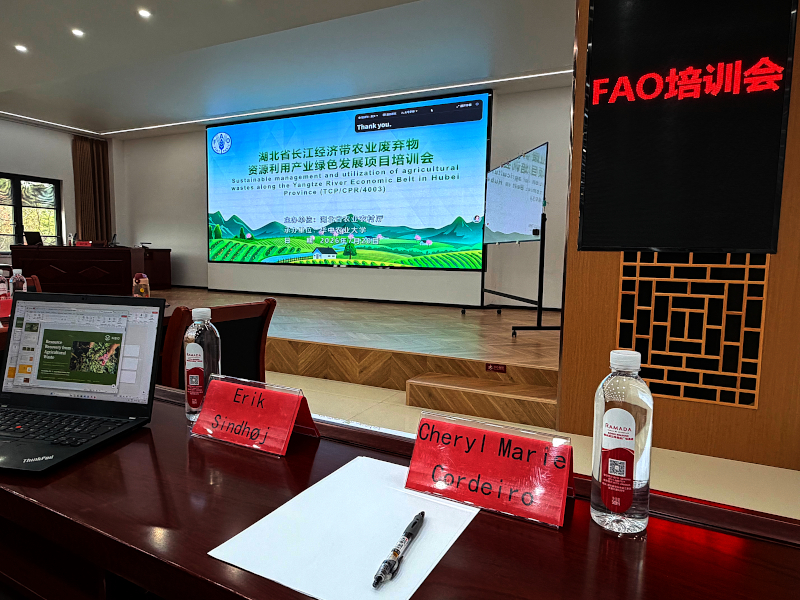
Photo and text copyright © 2026 CM Cordeiro
In July 2026, Erik Sindhøj and I were invited to join the third and final agricultural-waste training run by the United Nations Food and Agriculture Organization (FAO) in Ezhou, Hubei. Representing NIBIO, the Norwegian Institute of Bioeconomy Research, we presented on resource recovery from agricultural waste. Together with other international trainers, we helped support some 35 Chinese agri-environment officers as they learnt to become Farmer Field School facilitators, and we contributed a transferable, evidence-first framework for recovering value from manure, straw and mulch film in service of protecting the Yangtze.
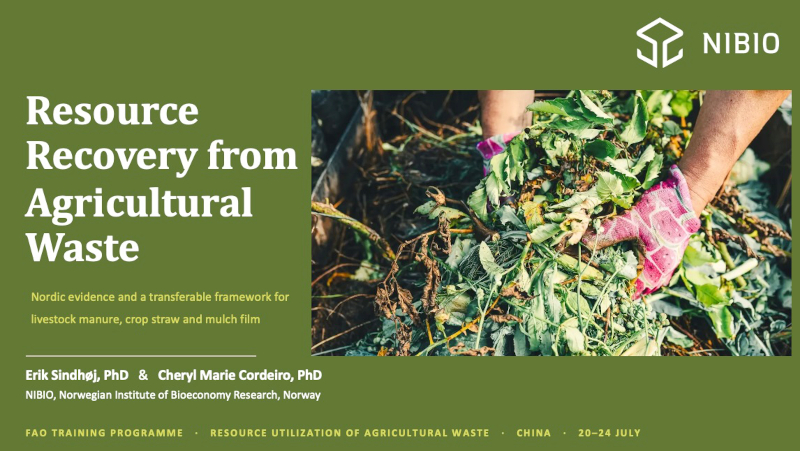
The opening slide of our NIBIO session, “Resource Recovery from Agricultural Waste”. The full presentation is available as a PDF: FAO_Resource_Recovery_AgWaste_v0.1 (PDF).
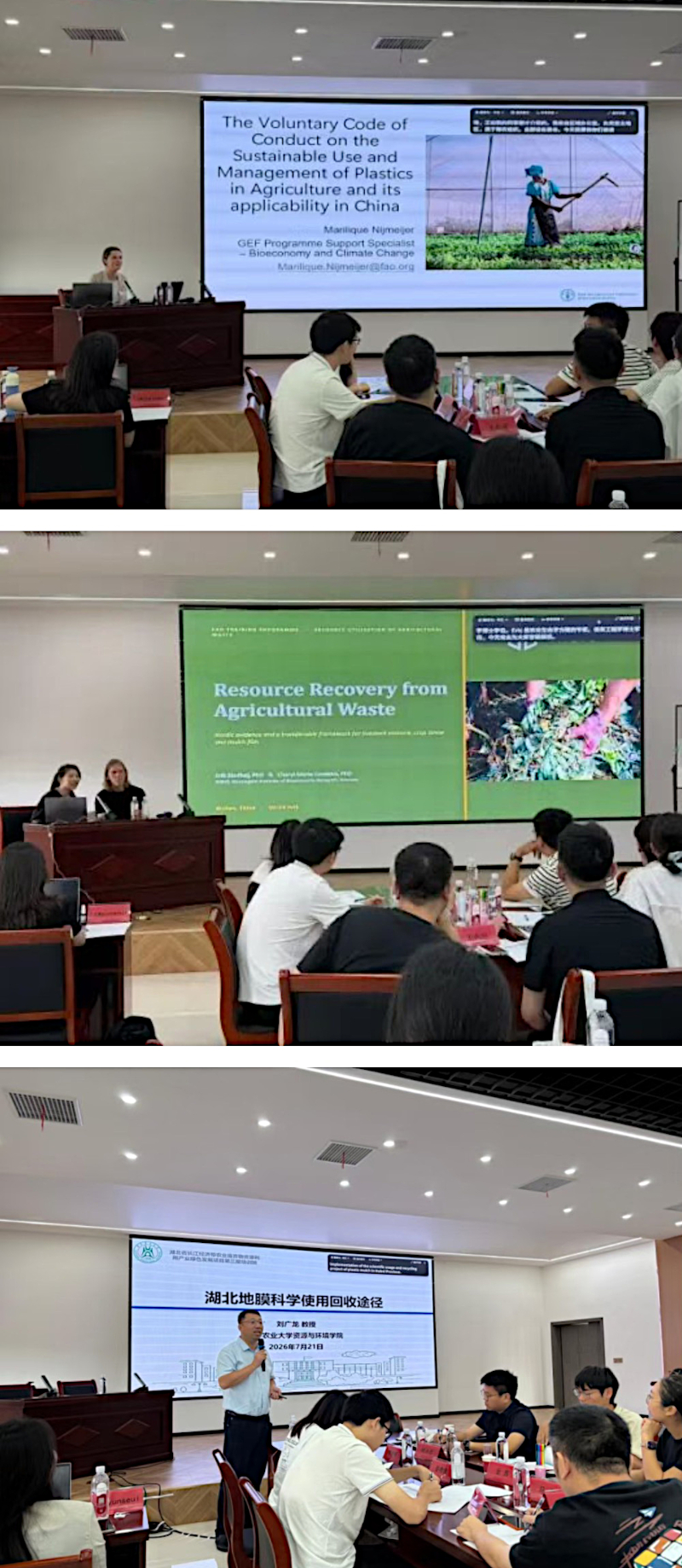
Three sessions from the training, as featured by the host university: FAO’s Marilique Nijmeijer presenting the Voluntary Code of Conduct on agricultural plastics; our NIBIO session, “Resource Recovery from Agricultural Waste”; and Professor Liu Guanglong of Huazhong Agricultural University on Hubei’s mulch-film recycling pathways.
This technical training was designed to leave a capability behind, and to make a direct and lasting impact. Ezhou sits on the Yangtze in Hubei, about eighty kilometres downstream of Wuhan, and over five days the participants worked through the last of the programme’s three phases, delivered by the Hubei Provincial Department of Agriculture and Rural Affairs and Huazhong Agricultural University under FAO’s technical-cooperation programme. We were honoured to take part alongside FAO and our Chinese partners and colleagues.
The programme’s framing is explicit and consequential: it is part of “Yangtze Great Protection”, the national effort to keep agricultural pollution out of China’s most important river system. Three threads run through this account: the programme’s strategic purpose, the hands-on training model that carried it, and the Nordic contribution we were there to make.
First thread: a capstone in a Yangtze-protection pipeline
This was not a one-off workshop. It was the closing instalment of a structured series that worked methodically through the three largest agricultural-waste streams in the region: livestock manure in the first phase, crop straw in the second, and waste agricultural mulch film in this third phase. Each phase paired a specific waste stream with the technologies, economics and field practices needed to turn it from a disposal problem into a recovered resource.
Framing the whole series around protection of the Yangtze gives the technical content a clear public purpose. Manure nutrients that run off, straw that is burned, and mulch film that fragments into “white pollution” are not only on-farm inefficiencies; along the Yangtze Economic Belt they are watershed-scale risks. The programme’s ambition, shared by all the partners, was to build the human capacity to address all three.
Second thread: a training model, not a lecture series
The most valuable feature on the ground was the pedagogy. The organisers designed a “theory + hands-on + observation” model that deliberately moved beyond the classroom. Participants did not simply absorb material; they rehearsed becoming trainers themselves, running a full Farmer Field School (FFS) demonstration at Dongshan Village and stepping into the facilitator’s role of briefing farmers and welcoming their questions.
The course then took participants along the full resource-recovery value chain through five field sites:
- Dongshan Village Farmer Field School, the demonstration and facilitation practicum;
- Hubei Jinhongyuan Plastics Co., the mulch-film collection and recycling industry chain;
- Hubei Zhimin Agri-Tech Co., black soldier fly conversion of agricultural waste;
- Ezhou Lanyan Biomass Energy Co., energy-recovery pathways; and
- the Ezhou mulch-film suitability trial base, in-field residue monitoring and performance comparison of different film types.
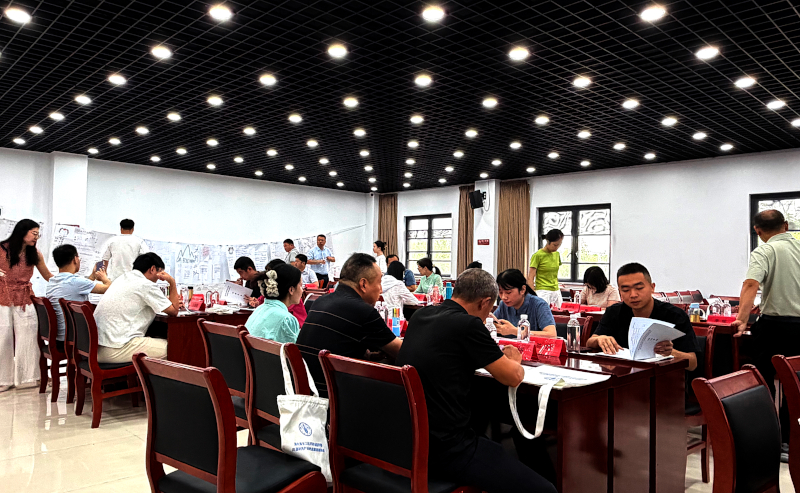
Linking these five sites, as the host university put it, closed the “last mile” from theory to field practice. The stated goal, and the achievement celebrated at the graduation ceremony on 22 July, was the transformation of participants from “theory learners” into “field facilitators” who will now carry the training to farmers in their own counties. Organised into Farmer Field School teams, with cheerfully competitive names, participants presented their results by video and live report before receiving completion certificates. The lasting product of the week was therefore not knowledge delivered but a corps of trainers built together.
Third thread: a Nordic contribution, method over numbers
Our session, “Resource Recovery from Agricultural Waste”, was designed to complement exactly this train-the-trainer purpose. We came not to export Nordic answers, but to offer a shared way of deciding whether any proposed recovery route is genuinely useful in a particular farming system. The core message was straightforward: transfer the method, not the numbers, because circularity is a system property rather than a label attached to a material.
The method is a single analytical lens of five linked questions, applied to the same three streams the whole programme addressed:
- Technology: can the resource be separated, stabilised or transformed?
- Economics and logistics: after collection, water removal, transport and storage, does the recovered product substitute for something farmers would otherwise buy?
- Safety: what happens to metals, pathogens, plastic particles and antibiotic residues? Recovering a nutrient and removing a contaminant are different claims.
- Policy and acceptance: is the product legally usable, quality-assured and trusted?
- Local proof: does it perform in this soil, climate, crop and season, and what evidence would count as proof?
We closed on four verbs to carry home, quantify, match, manage and verify, and on a discipline of evidence humility that a new facilitator corps particularly values. Biodegradable mulch film, for example, is not a field-specific degradation guarantee: in Nordic soils, two-year trials still recovered between 52 and 93 percent of the original film. Phosphorus in manure can be abundant nationally yet stranded in the wrong place, so the binding constraint is often spatial organisation rather than chemistry. And a process can recover a nutrient while leaving contaminants unresolved. The point we offered is to report the promise and the limit together, rather than a single recovery percentage in isolation.
This dovetailed with FAO’s own international input. FAO’s Marilique Nijmeijer (Asia-Pacific Regional Office) presented the Voluntary Code of Conduct on the Sustainable Use and Management of Plastics in Agriculture, while Chinese experts, Professor Liu Guanglong of HZAU among them, grounded the discussion in Hubei’s own mulch-film recycling pathways and residual-pollution control. International perspective and local practice were built into the timetable side by side.
A two-way relationship, not a one-way transfer
What made the week rewarding was that the exchange ran in both directions. The Nordic evidence gave participants a structured way to interrogate circular-economy proposals; the Chinese sites, at a scale and intensity Norway rarely sees, are precisely where such methods are best tested and refined. NIBIO’s ongoing collaboration with institutes under China’s Ministry of Agriculture and Rural Affairs, including work on microalgal treatment of livestock wastewater, is one strand of that continuing relationship, and one we hope to deepen.
Graduation is less an end than a starting point. The newly qualified facilitators now take their Farmer Field School plans back to project counties across Hubei. If the method travels as well as the participants’ commitment did, the “last mile” from Ezhou’s classroom to the province’s fields is well on its way to being closed. We are grateful to FAO, the Hubei Provincial Department of Agriculture and Rural Affairs, and Huazhong Agricultural University for the invitation and the warm collaboration throughout.